



What's Happening?
Federal Reserve Governor Christopher Waller has called for a more aggressive approach to combat inflation, suggesting a 50-basis-point interest rate hike at the Federal Open Market Committee's (FOMC) December 8-9 meeting. Waller expressed significant
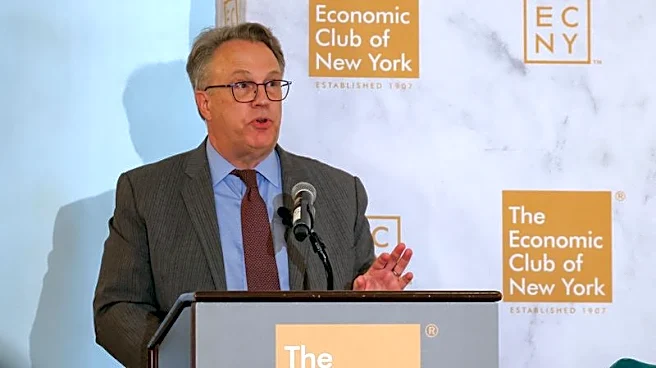
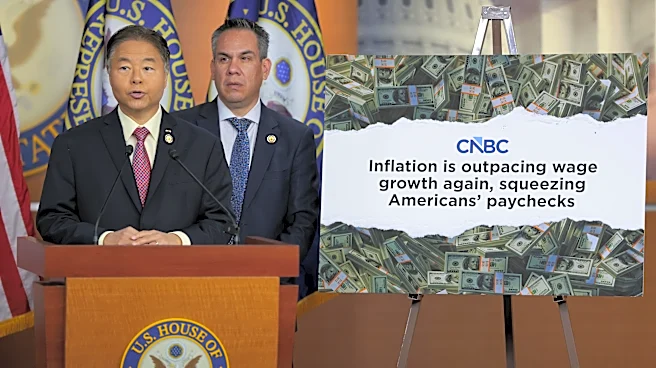
concern that inflation is worsening and spreading across the economy, indicating that current measures are insufficient to bring it down to the Fed's 2% target. He warned that businesses and consumers might be becoming accustomed to inflation around 3%, which could entrench higher expectations. Waller stated that a 25-basis-point increase would only be acceptable if accompanied by a clear signal of another hike in January; otherwise, a 50-basis-point increase in December is necessary. This stance contrasts with New York Fed President John Williams' assessment, who believes the current data-driven, meeting-by-meeting approach is effective and does not warrant dramatic action.
Why It's Important?
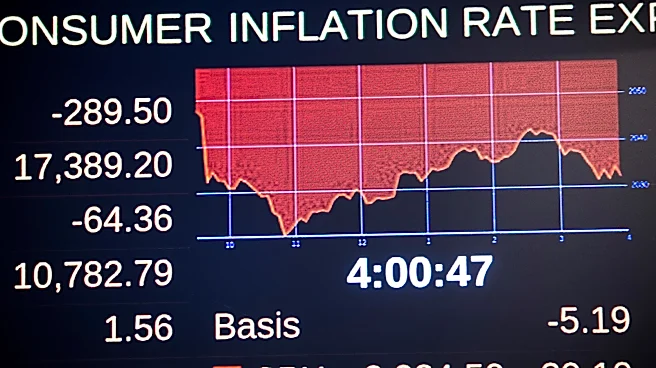
This divergence in opinion among Federal Reserve officials highlights a critical juncture in U.S. monetary policy. A more aggressive rate hike, as proposed by Governor Waller, could significantly impact borrowing costs for consumers and businesses, potentially slowing economic growth but aiming to curb persistent inflation. If the Fed adopts Waller's recommendation, it could lead to higher interest rates on mortgages, car loans, and business investments, affecting consumer spending and corporate expansion. Conversely, a less aggressive approach, favored by President Williams, might allow inflation to persist longer, eroding purchasing power and creating economic uncertainty. The decision will influence market expectations, with current futures pricing reflecting a more gradual tightening path. The outcome will determine the Fed's commitment to its 2% inflation target and its willingness to risk a more significant economic slowdown to achieve price stability.
What's Next?
The Federal Open Market Committee (FOMC) will convene for its December 8-9 meeting, where policymakers will decide on the next interest rate adjustment. The debate between a 50-basis-point hike and a more gradual 25-basis-point increase, potentially with forward guidance, will be central to their discussions. Market participants will closely monitor the FOMC's decision and accompanying statements for clues on the future trajectory of monetary policy. The outcome will likely influence bond yields, stock market performance, and the U.S. dollar's value. Further statements from other Fed officials, such as St. Louis Fed President Alberto Musalem, who suggested up to four rate increases by spring 2027, and Cleveland Fed President Beth Hammack and Dallas Fed President Lorie Logan, who favor a more gradual approach, will continue to shape the public and market's understanding of the Fed's strategy.
Beyond the Headlines
The growing divide within the Federal Reserve reflects a deeper challenge in managing inflation expectations. If consumers and businesses begin to anticipate sustained higher inflation, it can become a self-fulfilling prophecy, making the Fed's job significantly harder. Waller's suggestion of a 'shock' action underscores the psychological aspect of monetary policy, aiming to break the perception that 3% inflation is the new norm. This situation could lead to increased scrutiny of the Fed's communication strategy and its ability to maintain credibility. The long-term implications could include a re-evaluation of the Fed's inflation targeting framework or a more volatile interest rate environment as policymakers grapple with entrenched inflationary pressures. The debate also highlights the inherent tension between controlling inflation and supporting economic growth, a balance the Fed constantly strives to maintain.