



What's Happening?
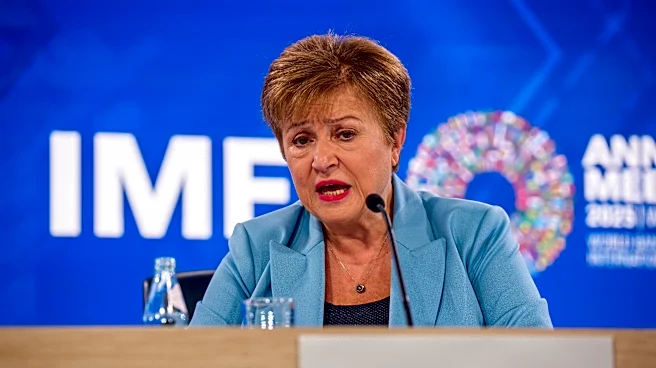
A new study led by Professor Kevin P. Gallagher, Director of the Global Development Policy (GDP) Center at Boston University's Frederick S. Pardee School of Global Studies, indicates that International Monetary Fund (IMF) lending programs rarely deliver
the promised investment boost. The research, titled “Adjustment without Accumulation: Evidence on Capital Formation from IMF Programs,” was published in the Journal of Development Economics. The study examined low- and middle-income countries from 1990 to 2024, focusing on gross fixed capital formation, which includes investments in infrastructure, machinery, and buildings essential for long-term growth. The findings suggest that participation in IMF programs had ambiguous or even negative effects on both total and private investment. While some lower-income countries experienced initial gains, these effects often diminished or reversed over time as programs continued. The IMF typically provides emergency loans during balance-of-payments crises, contingent on governments adopting policy reforms such as fiscal consolidation and liberalization, with the stated goal of encouraging private-sector-led growth and investments.
Why It's Important?
This research challenges a core premise of IMF lending programs, which assert that their conditional reforms foster private-sector-led growth and investment. If IMF programs are not effectively stimulating investment, it raises questions about their long-term efficacy in promoting sustainable economic development in recipient countries. Investment is widely considered a critical engine for economic growth and poverty reduction. The study's conclusions suggest that the austerity-first conditionality often imposed by the IMF may not be achieving its intended goal of capital formation. This could lead to prolonged economic stagnation in countries reliant on IMF assistance, potentially exacerbating existing economic vulnerabilities rather than resolving them. The findings contribute to a growing body of literature scrutinizing the IMF's impact on growth and social outcomes, prompting a reevaluation of current policy approaches.
What's Next?
The findings from this study are likely to fuel ongoing debates among policymakers, economists, and international development organizations regarding the effectiveness of IMF conditionalities. There may be increased pressure on the IMF to reconsider its approach to balance-of-payments crises, particularly concerning the emphasis on fiscal consolidation. This research could encourage a shift towards alternative strategies that prioritize investment and long-term growth more directly. Academic and policy discussions may focus on developing new frameworks for international financial assistance that better align with the goal of sustainable capital formation. Furthermore, countries seeking IMF assistance might use these findings to advocate for more flexible or growth-oriented program designs, potentially leading to reforms in how the IMF structures its lending agreements and policy recommendations.
Beyond the Headlines
The study's implications extend beyond immediate economic policy, touching upon broader ethical and developmental considerations. If IMF programs inadvertently hinder investment, they could perpetuate cycles of dependency and underdevelopment in vulnerable nations. This raises questions about the responsibility of international financial institutions to ensure their interventions genuinely foster sustainable prosperity rather than imposing policies that may have counterproductive effects. The research also highlights the complex interplay between global financial governance and national economic sovereignty, as countries often adopt IMF-mandated reforms under duress. A deeper examination of these dynamics could lead to calls for more equitable and context-sensitive approaches to global financial assistance, emphasizing local ownership and tailored development strategies over one-size-fits-all conditionalities. This could also influence the discourse around global economic inequality and the role of multilateral institutions in addressing it.