







What's Happening?
U.S. manufacturing is undergoing a significant transformation towards smart manufacturing, integrating connected digital technologies and data to enhance operational visibility, intelligence, automation, flexibility, and responsiveness. This shift, often
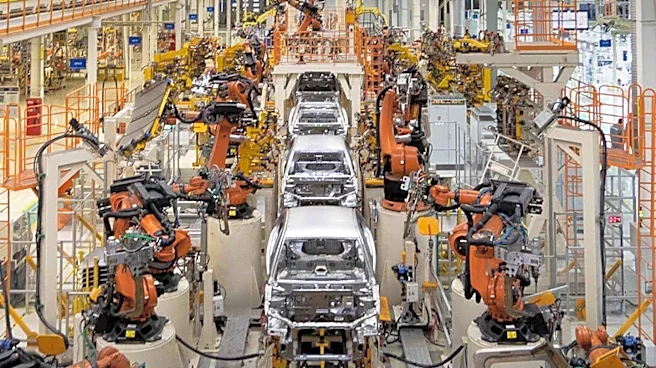
referred to as Industry 4.0, involves machines, software, people, and business systems working together through digital connectivity. Smart manufacturing goes beyond simply installing sensors or robots; it creates an environment where equipment collects information, understands its meaning, identifies potential problems before they escalate, adjusts production based on changing conditions, and provides real-time, actionable insights to managers. Key components include the Industrial Internet of Things (IIoT) for connecting devices, AI and machine learning for predictive analytics and optimization, robotics and cobots for automated tasks, cloud computing for data storage and processing, and digital twins for virtual simulations. The National Institute of Standards and Technology (NIST) describes smart manufacturing systems as adaptive, built around cyber-physical systems and data analytics, capable of real-time optimization of production and supply-chain networks.
Why It's Important?
The adoption of smart manufacturing is crucial for the competitiveness and resilience of U.S. industries. It promises higher productivity by identifying bottlenecks and reducing downtime through real-time monitoring. Quality is improved through automated inspection and early defect detection, while predictive maintenance significantly reduces unexpected equipment failures. This leads to greater flexibility in responding to market demands and improved decision-making based on comprehensive data. Enhanced traceability, particularly vital in regulated sectors like pharmaceuticals and automotive, also becomes possible. For the U.S. economy, this transformation can lead to more efficient resource utilization, reduced waste, and optimized energy consumption, contributing to sustainability goals. However, challenges such as high initial investment, integrating legacy equipment, ensuring data quality, and addressing cybersecurity risks need to be managed. The widening skills gap, with a growing demand for professionals in automation, robotics, data analysis, and AI applications, also poses a significant hurdle for the U.S. workforce.
What's Next?
The future of smart manufacturing in the U.S. will likely involve increasingly autonomous and adaptive production systems. AI is expected to become more sophisticated in interpreting complex operational data, and digital twins will play a larger role in simulation and optimization. Collaborative robots will work more closely with human counterparts, while edge computing will facilitate faster industrial decisions. Cloud platforms will continue to provide enterprise-level visibility across multiple plants. Generative AI may also emerge as a key interface for industrial information, allowing engineers to query systems for insights into operational issues. However, the success of these advancements hinges on developing robust standards, ensuring cybersecurity, promoting interoperability between diverse technologies, and addressing the workforce skills gap. Manufacturers are encouraged to start with high-value problems, establish baselines, conduct pilot projects, improve data quality, and carefully connect systems to demonstrate measurable value before scaling solutions across their operations.
Beyond the Headlines
Beyond the immediate operational benefits, smart manufacturing introduces deeper implications for the U.S. industrial landscape. The shift from reactive to predictive operations fundamentally alters maintenance strategies and quality control, moving towards proactive problem-solving. This transformation also redefines the role of human workers, shifting them from repetitive tasks to higher-value activities like problem-solving and decision-making, supported by AI. The ethical dimension of AI's role in decision-making, particularly the need for trustworthy, explainable, and reliable AI in high-stakes manufacturing environments, becomes paramount. The integration of IT and operational technology (OT) systems, while crucial for connectivity, also introduces new cybersecurity vulnerabilities that require careful management to protect critical infrastructure. Culturally, successful adoption requires overcoming employee resistance and fostering a mindset that embraces continuous learning and data-driven improvements. Ultimately, smart manufacturing is not just about technology; it's about creating an intelligent industrial ecosystem where information is continuously used to make better decisions and drive ongoing improvement.