





What's Happening?
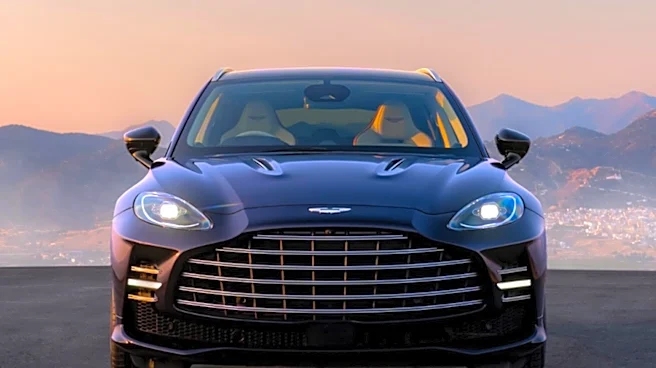
Aston Martin, the luxury car manufacturer, has accumulated after-tax losses totaling $3.1 billion since Canadian billionaire Lawrence Stroll led a rescue investment in 2020, according to Bloomberg. The company reported a pretax loss of £77 million ($102
million) in Q3 2026, an improvement from £111.9 million ($148 million) a year prior. Its net loss also decreased from £131.8 million ($175 million) to £78.8 million ($104 million). Despite these improvements, Aston Martin's net debt has reached £1.57 billion ($2.1 billion). The company's wholesale deliveries remained stable at 1,431 vehicles in Q3 2026, compared to 1,430 in the previous year. However, revenue saw a 36% increase to £389 million ($515 million), and gross profit jumped by 76%, attributed to a richer sales mix, particularly from high-priced models like the Valhalla.
Why It's Important?
Aston Martin's ongoing financial struggles, despite increased revenue and gross profit, highlight the significant challenges faced by luxury automotive brands in balancing high-end product development with profitability. The reliance on exclusive, high-priced models like the Valhalla to drive revenue growth indicates a strategy focused on niche markets, which can be volatile. The substantial debt burden of $2.1 billion and cumulative losses of $3.1 billion since 2020 raise concerns about the company's long-term financial stability and its ability to invest in future technologies and market expansion. U.S. tariffs and weaker demand in China are cited as contributing factors, demonstrating how global economic and trade policies directly impact even high-value industries. The company's investment in Formula 1, while a marketing platform, also represents a significant expenditure that needs to translate into tangible brand value and sales to justify its cost.
What's Next?
Aston Martin's future profitability hinges on the success of its upcoming high-priced models, such as the Valhalla Spider and the Valen, which is slated for Q2 2027. These models are designed to further enhance the company's sales mix and improve margins. The company will need to address its mounting debt and navigate ongoing challenges, including potential legal issues from bondholders like Arini Capital regarding financing arrangements. The partnership with Honda for Formula 1 power units, which began in the 2026 season, could lead to jointly developed road cars, potentially opening new revenue streams and technological advancements. However, the company must demonstrate that its engineering achievements can translate into sustained financial success and a clear path to profitability to reassure investors and stakeholders.
Beyond the Headlines
The narrative of Aston Martin's financial struggles, despite producing highly acclaimed vehicles, underscores a broader trend in the luxury automotive sector where brand prestige and engineering prowess do not always guarantee financial stability. The company's strategy of focusing on ultra-exclusive models like the Valhalla, while boosting revenue and gross profit in the short term, also highlights the inherent risks of relying on a limited customer base. This approach raises questions about market saturation for such high-end vehicles and the sustainability of growth. The interplay between its road car division and its Formula 1 team, while intended for global marketing, also represents a complex financial ecosystem where the success of one can influence the other, but also drain resources. The ongoing financial challenges could lead to further restructuring, strategic partnerships, or even changes in ownership as the company seeks to secure its long-term viability in a competitive global market.