



What's Happening?
Rob Minkoff, co-director of Disney’s 'The Lion King' and director of 'Stuart Little,' is in advanced discussions to develop and executive produce 'Storm Dogs' for UK-based Particle 6. Minkoff will serve as the film’s creative lead, collaborating with
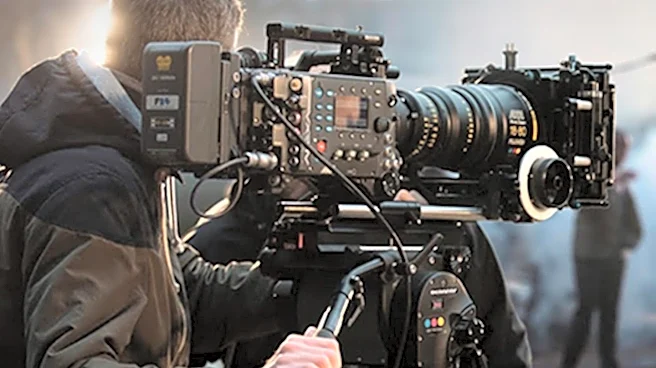
Particle 6 CEO Eline van der Velden to develop the story, characters, and screenplay for a planned 2027 production. The film is based on an original idea by Van der Velden and centers on a two-year-old girl named Poppy who becomes separated from her caregiver during a devastating storm in an English village. Five diverse dogs become her unlikely rescuers, attempting to carry her home through hazardous terrain over 24 hours. The movie will blend live-action performances with photorealistic animated characters. Human roles will be filmed conventionally, while Poppy and the dogs will be created using a combination of live-action performance, traditional filmmaking methods, and emerging AI technology. Particle 6 is developing a performance-driven process to translate actors' expressions and choices into animated characters, aiming to keep creative decisions in human hands.
Why It's Important?
This project is significant as it brings together a renowned filmmaker with a company at the forefront of integrating AI into film production. Rob Minkoff's involvement lends considerable creative weight and experience in developing beloved animal characters, suggesting a high standard for the film's narrative and character development. The use of AI technology by Particle 6, particularly after the debate sparked by their AI actor Tilly Norwood, highlights a growing trend in the entertainment industry. This approach aims to overcome traditional production challenges, such as filming with toddlers and multiple animals in extreme weather, by leveraging AI as a tool to enhance creative possibilities rather than replace human creativity. The project could serve as a case study for how AI can be responsibly integrated into filmmaking to achieve ambitious storytelling goals, potentially influencing future production methodologies across the industry. It also underscores the ongoing discussion about the role of AI in creative fields and the balance between technological innovation and human artistic control.
What's Next?
Particle 6 plans to move 'Storm Dogs' into production in 2027, with Rob Minkoff actively involved in developing the story, characters, and screenplay. The company will continue to refine its performance-driven AI process, which aims to translate actors' facial expressions, physicality, timing, and emotional choices into the animated characters. Eline van der Velden is also scheduled to return to the Zurich Summit to discuss the aftermath of Tilly Norwood's viral introduction, indicating ongoing engagement with industry discussions around AI in film. Furthermore, Tilly Norwood is slated to star in her own feature film, 'Misaligned,' also being developed by Particle 6. The progress of 'Storm Dogs' will likely be closely watched by the industry as it navigates the integration of AI, particularly concerning how the technology is used to enhance character performance and overcome production hurdles while maintaining creative control.
Beyond the Headlines
The 'Storm Dogs' project delves into deeper implications regarding the evolving landscape of filmmaking and the ethical considerations surrounding AI. Particle 6's explicit stance that AI is a tool to expand filmmakers' imaginations rather than replace human creativity sets a precedent for responsible AI integration. This approach could help shape industry standards for how AI is perceived and utilized, moving it from a controversial replacement to a valuable creative assistant. The film's blend of live-action and AI-generated elements also pushes the boundaries of visual storytelling, potentially leading to new aesthetic styles and production efficiencies. Furthermore, the project highlights the ongoing debate about authorship and control in AI-assisted creative works. By emphasizing human control over digital character performances, Particle 6 aims to address concerns about AI autonomously generating content, reinforcing the role of human artists in the creative process. This development could influence legal frameworks and industry guidelines for intellectual property and creative rights in the age of AI.