




What's Happening?
Jeremy Siegel, a professor at the University of Pennsylvania’s Wharton School, has offered insights into the recent market correction, particularly concerning the technology sector and the perceived 'AI bubble.' He suggests that the current decline is
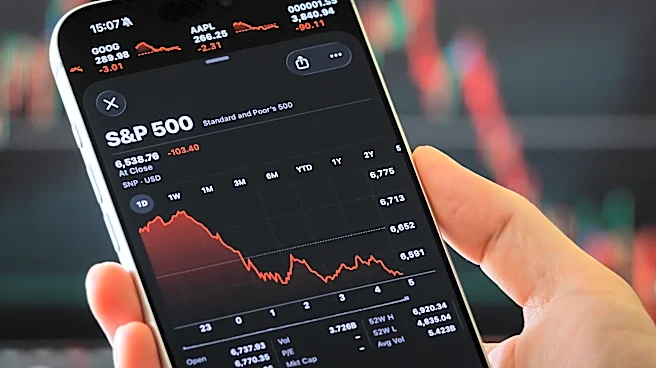
a natural adjustment within a bull market, rather than a full-blown bubble burst akin to the dot-com era. Siegel notes that the S&P 500 Index experienced significant growth, rising over 20% in both 2023 and 2024, which led investors to anticipate annual returns of 15-20% driven by AI. He contrasts this with the long-term average annual stock market growth of 8-9%. Despite sharp declines in tech stocks like NVIDIA and Oracle, and a 20% plunge in the Nasdaq Composite Index from its October 6 high, Siegel advises investors to retain their current stock holdings. He points out that U.S. consumer spending, a key economic driver, remains robust, as evidenced by Walmart's positive performance and raised forecasts, distinguishing the current situation from the dot-com bust which coincided with an economic recession.
Why It's Important?
Professor Siegel's perspective is important because it offers a counter-narrative to the widespread concern about an 'AI bubble' bursting, which could significantly impact U.S. financial markets and the broader economy. His view that the current downturn is a 'correction within a bull market' could influence investor sentiment, potentially preventing panic selling and stabilizing market volatility. If investors heed his advice to 'hold onto the stocks you have,' it could mitigate further market declines. The distinction he draws between the current economic climate and the dot-com bubble, particularly regarding consumer spending, highlights a crucial factor for economic resilience. A sustained decline in stock prices, as CNBC notes, could eventually lead to reduced consumption if household assets diminish, thereby impacting the U.S. economy. Therefore, understanding whether this is a temporary correction or a more severe downturn has significant implications for economic stability, consumer confidence, and investment strategies across various sectors.
What's Next?
The immediate future will likely involve continued monitoring of market performance, particularly in the technology sector, to determine if the current declines are indeed a temporary correction or the beginning of a more prolonged downturn. Investors will be watching for further indicators of consumer sentiment and spending, as these are crucial for the U.S. economy's resilience. Companies like Walmart, which serve as barometers of consumer health, will be closely observed for their earnings reports and forecasts. The debate between those who see an 'AI bubble' and those who view it as a market correction will continue, influencing investment decisions and market strategies. Should the market stabilize and consumer spending remain strong, Siegel's perspective may gain more traction. Conversely, a prolonged stock price decline could lead to reduced consumption, potentially triggering further market instability and prompting different economic analyses from experts.
Beyond the Headlines
Beyond the immediate market fluctuations, Professor Siegel's comments touch upon a deeper psychological aspect of investing: the expectation of returns. His observation that investors began expecting 15-20% annual returns due to AI highlights a potential disconnect between realistic long-term market averages and speculative enthusiasm. This 'irrational exuberance,' if unchecked, can lead to unsustainable asset valuations and subsequent sharp corrections. The comparison to the dot-com bubble serves as a historical cautionary tale, emphasizing the importance of fundamental economic indicators like consumer spending over speculative market trends. The long-term recovery period for some companies after the dot-com bust, such as Cisco taking 25 years to recover its peak, underscores the potential for significant wealth destruction if market corrections are misjudged. This situation also raises questions about the role of expert commentary in shaping public perception and investor behavior during periods of market uncertainty, influencing not just financial outcomes but also broader economic confidence.