








What's Happening?
Breedr, a precision livestock platform, has successfully raised $27 million in Series B funding. This investment, led by Partech Impact with participation from Latitude and Outsiders Fund, brings Breedr's total funding to $46.6 million. The company, founded
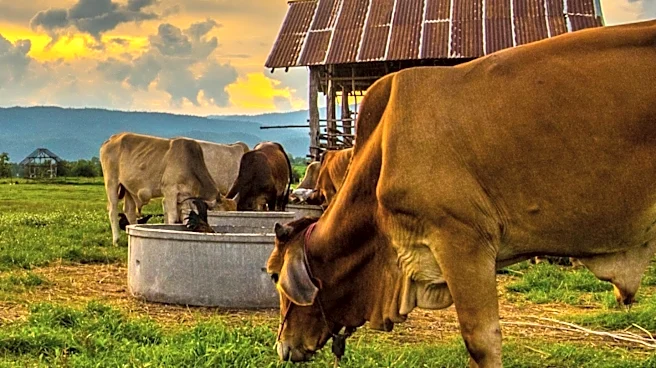
in the U.K. in 2018 and now headquartered in Austin, Texas, aims to digitize the global beef supply chain. Breedr's solution integrates a livestock management application, an AI-driven data-verified marketplace, and an embedded cattle finance fund. This platform tracks individual animal data, including weight, health, and family history, from birth to processing, optimizing growth and sales. Currently, over 2 million cattle are managed on the platform, with transactions totaling nearly $500 million this year. The company serves a diverse client base, from family ranches to operations managing over 100,000 cattle annually, and operates across the U.S., United Kingdom, Australia, New Zealand, and Europe.
Why It's Important?
This funding round is significant for the agricultural sector, particularly in the U.S., as it underscores the growing investment and reliance on artificial intelligence and data-driven solutions for livestock management. Breedr's technology addresses critical challenges in the beef supply chain, such as efficiency, sustainability, and animal welfare. By providing a digital record for each animal, the platform enhances traceability and transparency, which are increasingly important to consumers and regulators. The ability to track individual animal data from birth to sale allows for optimized resource allocation, improved animal health outcomes, and potentially higher quality beef production. This development could lead to more sustainable farming practices and better economic returns for ranchers and farmers, impacting the broader U.S. agricultural economy by fostering innovation and efficiency in a traditional industry.
What's Next?
The newly secured funding will be primarily used to expand Breedr's team, attract more ranchers and farmers to the platform, and enhance its capabilities to capture additional data points, such as genomic data. This expansion suggests a continued push towards more comprehensive data integration and advanced AI analytics in livestock management. The company's ambition to become the system of record for every major livestock-producing region indicates a strategic focus on global market penetration, with significant implications for the U.S. beef industry. As Breedr integrates more data and expands its user base, it is likely to further refine its AI models, leading to more precise insights into animal health, growth, and market timing. This could set new industry standards for efficiency and sustainability in cattle farming, potentially influencing how other livestock sectors adopt similar technologies.
Beyond the Headlines
The rise of platforms like Breedr highlights a broader trend of technological disruption in agriculture, moving towards 'precision livestock farming.' This shift has profound implications beyond immediate economic benefits. Ethically, enhanced monitoring can improve animal welfare by detecting abnormal behavior or health issues earlier, reducing suffering. Environmentally, optimized growth and resource management can lead to a smaller carbon footprint per animal, contributing to sustainability goals. Legally, increased traceability could simplify compliance with food safety regulations and provide greater transparency for consumers regarding the origin and treatment of their food. Culturally, it represents a modernization of farming practices, potentially attracting a new generation of tech-savvy agricultural professionals and changing public perception of industrial farming. The integration of AI into such fundamental industries also raises questions about data privacy, ownership, and the potential for algorithmic bias in agricultural decision-making.