





What's Happening?
Leju Robotics, a prominent Chinese manufacturer, has opened a 15,000-square-meter facility in partnership with Dongfang Precision Group, dedicated to producing humanoid robots. This factory, which launched in March 2026, aims to manufacture up to 10,000
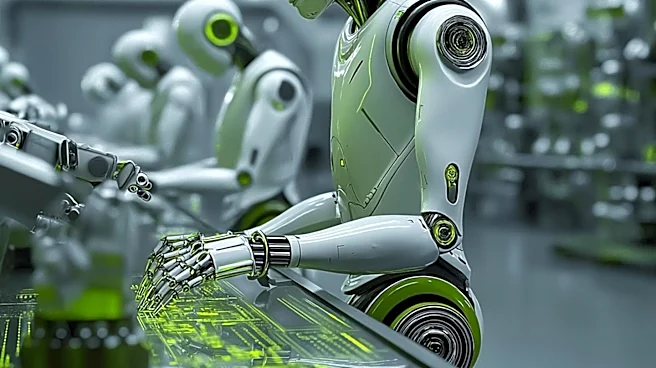
units annually. The robots are designed for various functions, including walking, dancing, and specific movements, with a focus on educational applications. CNN was granted access to the assembly line, observing the production of three different humanoid models. The robots are equipped with sensors and cameras to aid in orientation, though their 'brains' or programming are primarily handled by customers. Engineering director Huhehanggai stated that humanoid robots are envisioned as widely accessible tools.
Why It's Important?
The expansion of humanoid robot manufacturing by companies like Leju Robotics signifies a growing global investment in advanced robotics, particularly for educational purposes. This development could lead to significant advancements in how technology is integrated into learning environments, potentially making complex robotic systems more accessible for students and researchers. The high production capacity suggests an anticipated demand for these robots, which could foster innovation in AI and automation. For the U.S., this trend highlights the competitive landscape in robotics and the need for continued investment in domestic research and development to maintain technological leadership. The use of robots in education could also influence future workforce skills, emphasizing STEM fields and preparing students for an increasingly automated world.
What's Next?
With Leju Robotics aiming for an annual production of 10,000 units, the market will likely see an increased presence of these humanoid robots, particularly in educational sectors. Future developments will focus on how customers program and utilize these robots, pushing the boundaries of their applications beyond basic movements. The company will continue to refine the robots' sensors and functionalities, potentially leading to more sophisticated and autonomous capabilities. This expansion could also spur further competition and innovation among global robotics manufacturers, driving down costs and increasing the accessibility of advanced robotic technology. The long-term impact will depend on the adoption rates in educational institutions and the subsequent development of new applications.
Beyond the Headlines
The rise of mass-produced humanoid robots for educational purposes raises important ethical and societal questions. While these robots offer immense potential for learning and skill development, their increasing presence could also influence human-robot interaction dynamics and societal perceptions of AI. The reliance on customer programming for the robots' 'brains' highlights the critical role of human oversight and ethical guidelines in AI development. Furthermore, the accessibility of such technology could exacerbate the digital divide if not managed equitably, potentially creating disparities in technological literacy and opportunities. The long-term integration of humanoid robots into educational settings could reshape pedagogical approaches and the very nature of learning, prompting discussions about the balance between human instruction and AI-driven education.