








What's Happening?
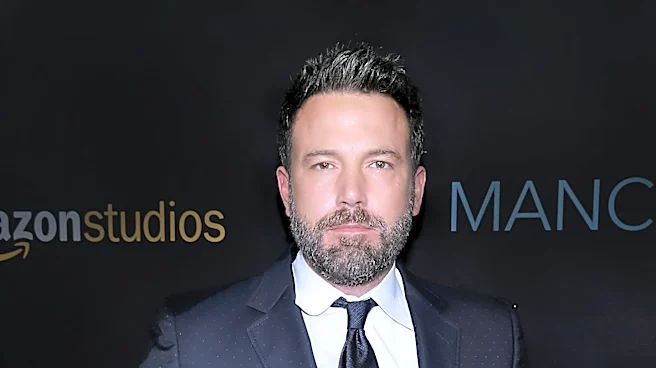
Ben Affleck's latest directorial effort, the 2026 film 'Animals,' is facing significant criticism for its heavy reliance on artificial intelligence in its production and its overall quality as a thriller. According to The Cosmic Circus, the film is described
as a 'lazy and dull mess' that feels algorithmic and devoid of human emotion, with AI being 'plastered all over its production.' Critics, including those cited by Rotten Tomatoes, have given the movie mixed to negative reviews, with some calling it a 'shocking misfire' and 'slick, friction-free, direct-to-streaming dross.' The plot involves Los Angeles mayoral candidate Mark Kimball (Ben Affleck) and his wife Abigail (Kerry Washington) dealing with the mistaken kidnapping of their son's friend, Hector, instead of their own son, Denny. The film is loosely based on Akira Kurosawa's 'High and Low' but is criticized for its underdeveloped ideas and uninspired cinematography.
Why It's Important?
The critical reception of 'Animals' highlights a growing concern within the film industry regarding the increasing use of artificial intelligence in creative processes. The Cosmic Circus explicitly states that the embrace of AI in mainstream cinema is 'the most depressing sight the medium has ever seen,' representing an 'abdication of creativity.' This development could have significant implications for the future of filmmaking, potentially leading to a decline in original human-driven artistic expression and a rise in algorithmically generated content. For audiences, this trend might result in a proliferation of films that lack emotional depth and narrative coherence, as suggested by the reviews of 'Animals.' For filmmakers and studios, the perceived cost-saving benefits of AI might be offset by negative critical and audience reactions, impacting box office performance and artistic reputation. The film's failure could serve as a cautionary tale for other productions considering extensive AI integration.
What's Next?
The overwhelmingly negative critical response to 'Animals' may prompt a reevaluation of the role and extent of AI in film production, particularly for high-profile projects. Filmmakers and studios might face increased scrutiny and pressure from critics and audiences to prioritize human creativity over AI-generated content. Ben Affleck, whose previous work as a filmmaker has been generally well-regarded, might need to address the criticisms regarding AI use in his future projects to maintain his artistic credibility. The film's poor performance could also influence investment decisions in AI-driven cinematic tools, potentially slowing down the rapid adoption of such technologies if they are perceived to compromise artistic quality. The debate around AI's ethical and creative implications in Hollywood is likely to intensify, with 'Animals' serving as a prominent example in the discussion.
Beyond the Headlines
The controversy surrounding 'Animals' extends beyond mere film criticism, touching upon deeper ethical and philosophical questions about the nature of art and creativity in the age of artificial intelligence. The Cosmic Circus article suggests that AI technology is 'built on theft' and 'plagiarizes the greatest artists,' raising concerns about intellectual property and the originality of AI-generated content. This development could lead to legal challenges and industry-wide debates about fair use and attribution in creative works. Furthermore, the film's perceived lack of 'human feeling' and 'algorithmic' nature could contribute to a broader cultural anxiety about the dehumanizing potential of technology. The long-term implications might include a shift in audience expectations, where films explicitly created with minimal AI involvement could be valued more highly, or conversely, a normalization of AI-assisted content, leading to a redefinition of what constitutes 'art' in the digital age.