




What's Happening?
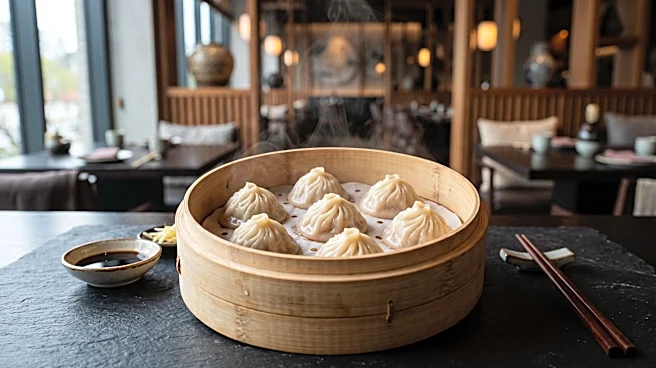
The latest New York Times crossword puzzle, constructed by Zhou Zhang, presented solvers with a mix of familiar and obscure terms, leading to a challenging experience for some. Notably, the puzzle included 'XIAOLONGBAO' (a type of Chinese soup dumpling)
and 'WEBBY AWARD' (an honor for internet excellence). The constructor, Rex Parker, described the puzzle as 'Easy-Medium' but admitted to failing to finish it correctly due to difficulties with the intersection of 'FIXE' and 'XIAOLONGBAO'. Parker also highlighted the appearance of 'FAQIR' (Muslim or Hindu holy person) over the more common 'FAKIR', and the repeated use of 'EVO' (referring to an annual esports event) in recent puzzles. The inclusion of 'KNITWORTHY' and 'YAWPS' also proved to be points of contention for some solvers.
Why It's Important?
The New York Times crossword puzzle holds significant cultural relevance in the U.S., often reflecting and influencing popular vocabulary and general knowledge. The inclusion of terms like 'XIAOLONGBAO' can introduce solvers to diverse cultural concepts and culinary traditions, broadening their understanding of global influences. Similarly, 'WEBBY AWARD' highlights the ongoing evolution of digital culture and its recognition. The debate over spellings like 'FAQIR' versus 'FAKIR' and the repeated use of 'EVO' underscore the dynamic nature of language and how certain terms gain or lose prominence. For enthusiasts, these puzzles are not just a pastime but a mental exercise that tests their linguistic and general knowledge, making the choice of words and clues a subject of keen interest and discussion.
What's Next?
Crossword puzzle enthusiasts will continue to engage with new puzzles, anticipating both familiar and novel challenges. The discussions surrounding specific clues and answers, as seen with 'XIAOLONGBAO' and 'FAQIR', are likely to persist in online forums and communities dedicated to crosswords. The American Crossword Puzzle Tournament, scheduled for April 30-May 2, 2027, in Philadelphia, PA, will be a significant event for the community, bringing together solvers to test their skills. The ongoing evolution of 'neo-crosswordese' terms, such as 'EVO', suggests that future puzzles will continue to incorporate contemporary references, reflecting current trends and events in technology, culture, and other domains.
Beyond the Headlines
The New York Times crossword puzzle, beyond its role as a daily brain teaser, serves as a subtle barometer of cultural literacy and linguistic shifts. The inclusion of non-English terms like 'XIAOLONGBAO' reflects an increasing global awareness and the integration of diverse cultural elements into mainstream American consciousness. The discussion around 'WEBBY AWARD' points to the pervasive influence of the internet and digital media on daily life and the need for new forms of recognition in this space. The puzzle also highlights the subjective nature of language and knowledge, where what is common to one solver might be obscure to another, fostering a continuous learning process and a shared intellectual pursuit among its dedicated audience.