
What's Happening?
Multiply Labs, a robotics startup based in San Francisco, has successfully raised $75 million in a Series B funding round, bringing its total funding to over $100 million since its inception in 2016. The
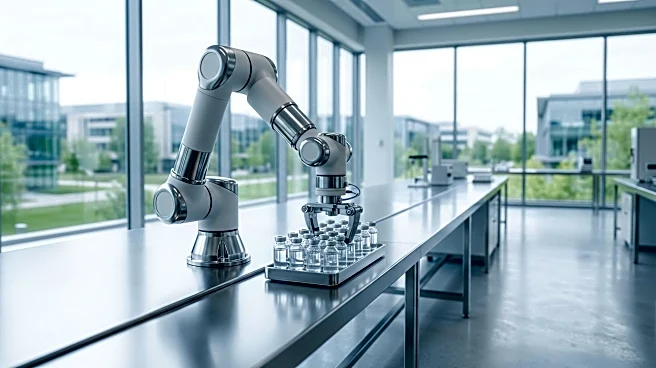
funding round was led by NantWorks, a holding company founded by billionaire Patrick Soon-Shiong, with additional investments from AstraZeneca, Lux Capital, and Founders Fund. Multiply Labs specializes in building robots that automate the production of complex drugs, including gene therapies and mRNA treatments. These types of drugs are currently largely manufactured manually in laboratories, a process that is slow, difficult to scale, and prone to human error and contamination. The company's CEO, Fred Parietti, emphasized that robotics are essential to achieve the necessary throughput, cost reduction, and quality control for these advanced therapies. Multiply's robots are deployed with a small group of customers, including drugmakers like AstraZeneca and Legend Biotech, who operate the machines at their own facilities. The company also generates revenue from cartridges used in the machines and from service and support.
Why It's Important?
The significant investment in Multiply Labs underscores a growing trend in the pharmaceutical industry towards automation and the adoption of 'physical AI' to address critical challenges in drug manufacturing. The manual production of gene therapies and mRNA treatments is not only inefficient but also incredibly expensive, with some gene therapies costing over $1 million per dose. By automating these processes, Multiply Labs aims to drastically reduce manufacturing costs and increase scalability, making these life-saving treatments more accessible. This development has the potential to transform the pharmaceutical landscape, particularly in the U.S., by accelerating the production of advanced therapies and improving their quality and consistency. The involvement of major pharmaceutical companies like AstraZeneca as both investors and customers highlights the industry's recognition of the urgent need for such technological advancements. This shift could lead to a more robust and resilient drug supply chain, less susceptible to human error and contamination, ultimately benefiting patients and the healthcare system.
What's Next?
Multiply Labs' immediate next step is to scale its operations and demonstrate its ability to transition from deploying a small number of expensive, specialized machines to establishing a scalable manufacturing business. The company will focus on expanding its customer base and further refining its robotic systems to meet the growing demand for automated drug production. As investors continue to pour money into 'physical AI' systems, Multiply Labs will likely face increased competition, necessitating continuous innovation in its technology and business model. The success of Multiply Labs could pave the way for broader adoption of robotics in pharmaceutical manufacturing, potentially leading to new industry standards for efficiency, cost-effectiveness, and quality control. Future developments may include the integration of more advanced AI capabilities into their robots, further optimizing drug production processes and potentially expanding into other areas of biotechnology manufacturing.
Beyond the Headlines
The automation of drug manufacturing by companies like Multiply Labs has profound implications beyond mere cost reduction and efficiency. It touches upon the ethical considerations of access to advanced medical treatments, particularly for rare diseases where gene therapies are often the only option. By making these treatments more affordable and widely available, robotics could help address health inequities. Furthermore, the reliance on a supply chain spread across Europe for building these robots highlights the global interconnectedness of advanced manufacturing and the potential vulnerabilities that could arise from geopolitical or logistical disruptions. The shift towards automated, AI-driven manufacturing also raises questions about the future of labor in the pharmaceutical sector, potentially leading to a demand for new skill sets in robotics and AI management. This technological evolution could also accelerate the pace of drug discovery and development, as more efficient manufacturing processes allow for quicker iteration and testing of new therapies.