







What's Happening?
Princess Margaret, sister of Queen Elizabeth II, acquired the Poltimore Tiara in 1959 for 5,500 pounds, an amount equivalent to 166,000 pounds today when adjusted for inflation. This purchase was made from her personal funds at an auction, distinguishing
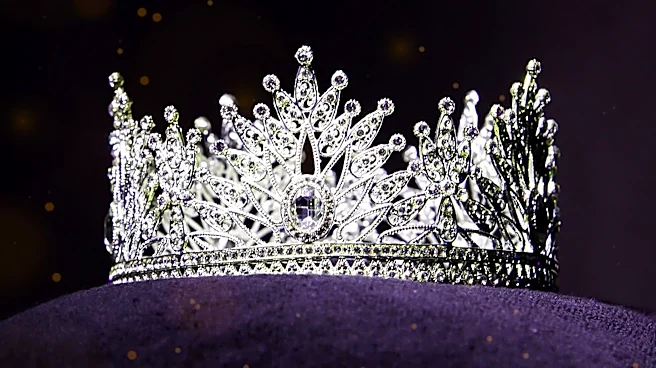
it as the only one of her five tiaras not sourced from the royal collection. The tiara, originally crafted by Garrard for Lady Florence, wife of the second Baron Poltimore, in 1870, is notable for its imposing size and intricate floral design, featuring rosebuds and volutes set with old-cut diamonds. Its versatility allows certain elements to be worn as pendants or as 11 distinct brooches. Princess Margaret famously wore this tiara on her wedding day on May 6, 1960, choosing it over pieces from the royal collections. After her passing, her children opted to sell the tiara, along with other personal belongings, at an auction to cover inheritance taxes. It was sold to an anonymous buyer for over one million euros.
Why It's Important?
The story of Princess Margaret and the Poltimore Tiara offers a unique glimpse into the personal choices and financial independence within the British royal family. Her decision to purchase a tiara with her own money, rather than relying on the extensive royal collection, underscores a desire for individuality and self-expression. This act highlights the evolving dynamics within monarchies, where personal acquisitions can hold significant symbolic weight. The subsequent sale of the tiara by her children to manage inheritance taxes also sheds light on the financial realities faced by royal descendants, demonstrating that even those connected to the Crown are subject to common fiscal obligations. This event provides a historical precedent for how royal assets, particularly those with personal significance, are managed and transitioned across generations, impacting both the family's legacy and the broader market for historical jewelry.
What's Next?
While the Poltimore Tiara is now in anonymous private hands, its story continues to resonate within discussions of royal history and personal autonomy. The sale of such a significant piece of jewelry often sparks interest in its provenance and future whereabouts, though details are likely to remain private. The precedent set by Princess Margaret's personal acquisition and her children's subsequent sale could influence future generations of royals in how they manage their personal wealth and inherited assets. This event may also encourage further academic or public interest in the personal collections of historical figures, prompting deeper dives into the stories behind their possessions and the decisions surrounding their acquisition and dispersal. The tiara's journey from a noble family to a princess, and then to an anonymous buyer, exemplifies the fluid nature of ownership for high-value historical artifacts.
Beyond the Headlines
The Poltimore Tiara transcends its material value, serving as a powerful symbol of Princess Margaret's quest for individuality within the confines of royal life. Her choice to acquire a tiara independently, and to wear it on her wedding day, speaks to a desire to forge her own path, distinct from the expectations and traditions of the Crown. This act can be interpreted as a subtle rebellion against the strictures of royal protocol, highlighting her spirited and often unconventional personality. The tiara's journey, from its creation for a baroness to its acquisition by a princess and eventual sale, also reflects broader themes of heritage, ownership, and the intersection of personal and public life for figures in the public eye. It underscores how personal possessions can become imbued with historical and emotional significance, telling a story that extends far beyond their intrinsic worth.