
What's Happening?
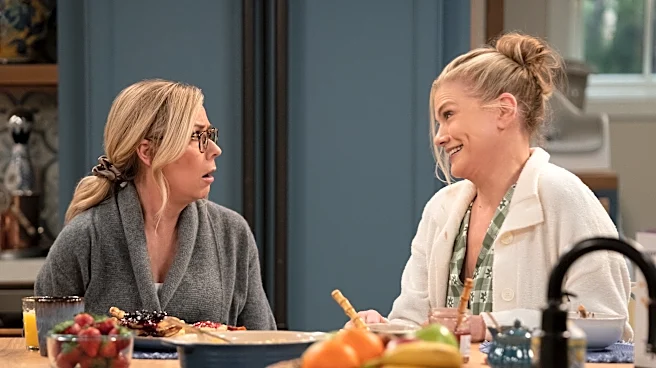
Comedian Leanne Morgan, star and executive producer of the Netflix sitcom 'Leanne,' has discussed the challenges of accurately portraying her Southern voice and Christian background in the show's second
season. Morgan, who relocated from Tennessee to Los Angeles for filming, initially expressed concern that the writers' room might stereotype the South and church-going individuals. She noted that many of her writers were not raised in a church environment, leading to initial apprehension about their ability to authentically capture her perspective. Morgan emphasized the importance of her Southern identity and faith being represented accurately, stating that she had to give the writers 'grace' as they learned to understand her background. She also mentioned actively rewriting scripts to infuse her authentic voice, citing examples like specifying 'Dukes Mayonnaise' over 'Miracle Whip' to reflect Southern cultural nuances. The second season of 'Leanne' is currently available for streaming on Netflix.
Why It's Important?
This situation highlights the broader cultural and regional divides that can emerge in content creation within the entertainment industry. Morgan's experience underscores the potential for misrepresentation when creative teams lack direct experience with the cultural backgrounds they are depicting. Her active involvement in the writing process to ensure authenticity is crucial for connecting with audiences who share similar experiences and for avoiding caricatures. This also speaks to the growing demand for diverse and nuanced storytelling that accurately reflects the varied experiences across the United States, particularly from regions often stereotyped in mainstream media. The success of 'Leanne' in capturing a Southern voice could pave the way for more authentic regional narratives in Hollywood, potentially influencing how other productions approach cultural representation.
What's Next?
The ongoing success of 'Leanne' on Netflix, particularly with its second season, could encourage other streaming platforms and production companies to invest in projects that prioritize authentic regional voices and experiences. Morgan's role as an executive producer, allowing her significant creative control, may serve as a model for other artists seeking to ensure their stories are told faithfully. This could lead to a greater emphasis on diverse writers' rooms that include individuals from various cultural and geographical backgrounds. Furthermore, the discussion around avoiding stereotypes in entertainment may prompt more critical evaluations of how different American subcultures are portrayed on screen, potentially leading to a richer and more accurate landscape of U.S. storytelling.
Beyond the Headlines
Morgan's comments about Hollywood being in a 'bubble' and missing the market for Christian entertainment touch upon a significant, often overlooked, segment of the U.S. audience. Her assertion that many people in the 'middle of the United States' are not interested in 'over-sexualized projects' suggests a potential disconnect between mainstream Hollywood productions and the values of a substantial portion of the American public. This raises questions about the industry's understanding of its diverse viewership and the types of content that resonate beyond coastal cultural centers. If successful, 'Leanne' could demonstrate the commercial viability of content that appeals to these underserved demographics, potentially influencing future production strategies and leading to a broader range of family-friendly or faith-based programming that avoids stereotypes and offers authentic representation.