


What's Happening?
SpaceX's Superintelligence (SI) segment generated $7.6 billion in revenue in the third quarter of 2026, marking an 830% year-over-year increase. This growth primarily stems from renting out compute capacity to other AI companies. However, the segment is encountering
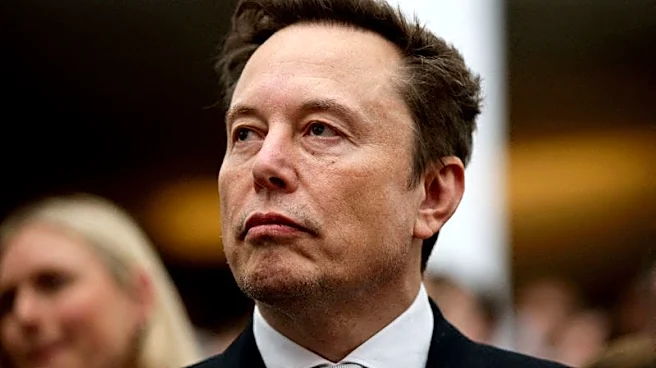
significant bottlenecks related to electricity supply. CEO Elon Musk stated that the primary constraint on superintelligence deployment is power, cooling, and infrastructure, rather than chips. SpaceX's IPO prospectus previously warned about the U.S. grid's potential inability to meet AI power demands. The company reported 1.7 gigawatts (GW) of nameplate compute in Q3 2026, an increase from 0.6 GW a year prior. SpaceX aims to reach approximately 3 GW by the end of the current year and plans to add at least 10 GW by the end of 2027, with a challenging target of 20 GW. To address power issues, SpaceX intends to leverage its advanced casting capabilities from its rocket business to produce gas turbine blades and vanes, potentially accelerating power infrastructure deployment by 12 to 18 months.
Why It's Important?
The rapid expansion of SpaceX's AI segment highlights the increasing demand for high-performance computing infrastructure, which is becoming a critical component of the broader technology landscape. The power constraint issue faced by SpaceX underscores a significant challenge for the entire AI industry: the availability and reliability of energy resources. If the U.S. grid cannot keep pace with AI's escalating power demands, it could impede technological advancement and economic growth in the sector. SpaceX's strategy to vertically integrate power component manufacturing, such as turbine blades, could set a precedent for other large-scale tech companies seeking to mitigate supply chain dependencies and accelerate infrastructure build-out. The success or failure of SpaceX in overcoming these power challenges could influence investment trends and strategic planning across the AI and energy sectors, potentially driving innovation in power generation and distribution solutions.
What's Next?
SpaceX plans to continue its aggressive expansion of compute capacity, targeting 3 GW by the end of the current year and at least 10 GW by the end of 2027, with an ambitious goal of 20 GW. The company is also exploring long-term solutions, including the development of space-based compute with solar-powered, orbital data centers, with production and deployment potentially starting as early as late 2027. This initiative, however, relies on unproven technologies and faces challenges such as space radiation and thermal dissipation in a vacuum. Financially, SpaceX's SI segment incurred $40 billion in capital expenditures over the first nine months of the year, with an additional $35 billion to $40 billion projected for the fourth quarter. While current deployments are reported to pay for themselves in under a year, a potential decline in compute prices could diminish future returns, posing a financial risk to these ambitious expansion plans.
Beyond the Headlines
The challenges faced by SpaceX in scaling its AI operations due to power constraints reveal a deeper systemic issue concerning the energy infrastructure's readiness for the burgeoning demands of advanced technology. The reliance on 'unproven technologies' for orbital data centers introduces significant technological and financial risks, highlighting the speculative nature of some long-term solutions in the tech industry. Furthermore, the substantial capital expenditures involved in building out AI infrastructure raise questions about the sustainability of such growth models and the potential for market saturation or price erosion in compute services. The ethical implications of concentrating vast computing power, and thus influence, within a few private entities also warrant consideration, as does the environmental impact of the massive energy consumption required for these operations, even if sourced from renewables in space. This scenario underscores the complex interplay between technological ambition, economic viability, and infrastructural limitations.