






What's Happening?
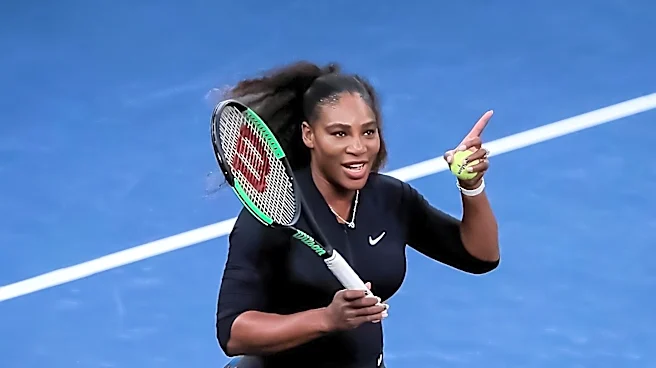
Serena Williams, one of the most dominant figures in tennis history, made an unexpected return to professional competition in 2026, nearly four years after announcing her retirement. Her comeback began in June at the Queen's Club Championships in London,
where she played doubles with Canadian player Victoria Mboko. Following this, Williams entered the Wimbledon singles draw as a wildcard, losing her opening match to Australian player Maya Joint and sustaining a knee injury that led to her withdrawal from the doubles event with her sister Venus. In August 2026, she continued her return by playing doubles with Venus at Cincinnati and the US Open, and mixed doubles with Carlos Alcaraz at the US Open. Despite not winning any titles during this period, her return at the age of 44 has been a significant event in the tennis world, prompting discussions about her motivations and the future of her career.
Why It's Important?
Serena Williams's return to professional tennis is significant for several reasons. Her initial retirement in 2022 marked the end of an era for many fans and commentators, and her comeback challenges the conventional timelines for athletes in professional sports, especially after motherhood. Her decision to return at 44, after a substantial break, highlights her enduring passion for the game and her desire to compete at the highest level. This return could inspire other athletes, particularly women who have taken breaks for family, to consider extended careers. Furthermore, her presence on the court, even without immediate title wins, draws considerable media attention and viewership, benefiting the sport's popularity and potentially increasing engagement from a new generation of fans who may not have witnessed her prime. Her career has consistently pushed boundaries, from her powerful playing style to her advocacy for maternal health, and this latest chapter continues to shape narratives around athletic longevity and personal ambition.
What's Next?
The immediate future for Serena Williams following her 2026 comeback remains uncertain. She has not announced a full schedule, leaving open questions about whether this return is a temporary 'farewell tour,' a final opportunity to play alongside her sister Venus, or the beginning of a more sustained return to the sport. The tennis world will be closely watching for any further announcements regarding her participation in upcoming tournaments. Her performance and physical condition will likely dictate the extent of her continued involvement. Stakeholders, including tournament organizers, sponsors, and fans, will be eager to see if she can regain competitive form or if her return will primarily serve as a celebratory final chapter to her illustrious career. The impact of her knee injury sustained at Wimbledon will also be a crucial factor in determining her next steps.
Beyond the Headlines
Serena Williams's 2026 comeback extends beyond mere athletic competition, touching upon broader themes of ageism in sports, the evolving role of mothers in professional careers, and the enduring power of personal legacy. Her return challenges societal expectations about when athletes, particularly women, should conclude their careers. It also reinforces her long-standing influence on the Women's Tennis Association (WTA), which previously adjusted rules to protect the rankings of returning mothers, a change partly influenced by her own experience. Her career has consistently been intertwined with discussions about race, gender, and social justice, and her continued presence in the public eye, even in this new phase, will likely keep these conversations active. This unexpected second act in her career serves as a powerful reminder that for some individuals, the pursuit of passion and the desire to redefine limits can transcend conventional timelines and expectations.