
What's Happening?
BYD, a prominent motor vehicle manufacturer, has unveiled its new flagship electric minivan, the 'Whale,' at the Guangzhou Auto Show on November 27. This vehicle is the first multi-purpose vehicle (MPV)
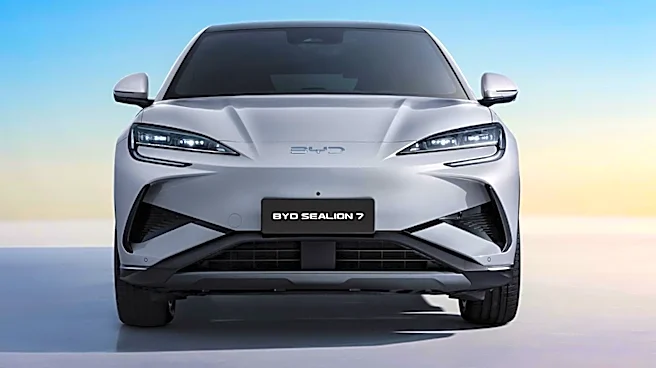
from BYD's Ocean series and is set to launch in the first quarter of 2027. The Whale will be available in both plug-in hybrid (PHEV) and pure electric (EV) powertrains, utilizing BYD’s latest Blade Batteries 2.0. The EV variant boasts an impressive range of over 559 miles (900 km) on a single charge, while the PHEV version offers a pure-electric CLTC range of 248 miles (400 km). The minivan also features BYD’s Flash Charging technology, allowing it to charge from 10% to 70% in just five minutes. Measuring 5,270 mm long, 1,996 mm wide, and 1,815 mm tall, with a 3,130 mm wheelbase, the Whale is slightly longer than the Chrysler Pacifica. It incorporates BYD’s updated Ocean design with smooth edges and a double-layer staggered grille, and will include BYD’s latest Advanced Driver Assistance System (ADAS) with LiDAR on the roof.
Why It's Important?
The introduction of BYD's 'Whale' electric minivan signifies a notable advancement in electric vehicle technology and market competition, particularly in the MPV segment. Its extended range of over 559 miles and rapid charging capabilities could set new benchmarks for consumer expectations in electric family vehicles. This development could intensify competition for U.S. automakers and those operating in the U.S. market, pushing them to innovate further in battery technology, range, and charging infrastructure. The Whale's expected starting price of around 300,000 yuan ($45,000) positions it as a competitive option, potentially influencing pricing strategies and feature offerings across the global EV market. For U.S. consumers, this could eventually translate into more advanced and affordable electric minivan options as manufacturers strive to keep pace with global innovations. The integration of advanced driver-assistance systems (ADAS) also highlights a growing trend towards safer and more autonomous driving experiences, which will likely become standard expectations in future vehicle designs.
What's Next?
The BYD Whale is scheduled to go on sale in the first quarter of 2027. Leading up to its launch, more detailed specifications, pricing for various trims, and market availability plans are expected to be revealed. As BYD expands its global presence, there will be keen observation on whether the Whale will be introduced to markets outside of China, including potential entry into the U.S. market, which could significantly impact the competitive landscape for electric minivans. Competitors, both in the U.S. and internationally, will likely analyze the Whale's features and pricing to inform their own product development and market strategies. The performance of BYD's Blade Batteries 2.0 and Flash Charging technology in real-world conditions will also be closely monitored, potentially influencing future battery and charging infrastructure developments across the automotive industry. The success of the Whale could further solidify BYD's position as a global leader in electric vehicle innovation.
Beyond the Headlines
The unveiling of the BYD Whale with its impressive range and charging speed points to a broader shift in consumer expectations for electric vehicles, moving beyond basic functionality to demand performance parity or superiority over traditional internal combustion engine vehicles. This development could accelerate the decline of gasoline-powered minivans, particularly if the Whale's technology proves reliable and cost-effective. Furthermore, the emphasis on advanced driver-assistance systems (ADAS) with LiDAR technology underscores the industry's push towards higher levels of autonomous driving, raising important ethical and regulatory questions about vehicle autonomy and safety standards. The global competition in the EV sector, exemplified by BYD's continuous innovation, also highlights geopolitical implications, as nations vie for technological leadership and control over critical supply chains for battery components and rare earth minerals. This could lead to increased investment in domestic EV manufacturing and battery production in countries like the U.S. to reduce reliance on foreign suppliers.