
What's Happening?
Tsingke Biotech is advancing its 'AI + Molecular Manufacturing' strategy by integrating scalable synthesis, high-throughput experimentation, and laboratory automation. The company, specializing in nucleic
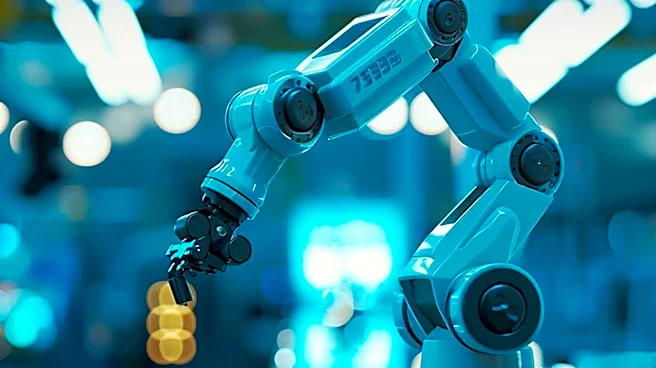
acid and gene synthesis solutions, aims to support data-driven molecular research and development. Tsingke's fully automated oligonucleotide platform combines synthesizers, purification systems, microplate readers, and automated dispensing systems, coordinated by a six-axis robotic arm. This system manages the workflow from phosphoramidite-based synthesis to finished oligonucleotide products. Additionally, Tsingke applies automation to PCA product preparation, sequencing, and nucleic acid extraction and purification, ensuring experimental consistency, traceability, and structured data collection. This approach aligns with the concept of self-driving laboratories, where AI prioritizes candidates for testing and automated systems support experiments, with data informing subsequent design decisions.
Why It's Important?
This initiative by Tsingke is important because it represents a significant step towards industrializing and accelerating molecular R&D through the synergy of AI and automation. By streamlining complex laboratory workflows, Tsingke aims to reduce human error, increase throughput, and generate more reliable and traceable data. This integration is crucial for drug discovery, functional genomics, and genetic engineering, potentially leading to faster development of new therapies and biotechnological products. The ability to rapidly design, build, test, and learn from molecular experiments, guided by AI, could dramatically shorten the timelines for bringing innovations to market, impacting various sectors from medicine to materials science. The emphasis on structured data collection also lays the groundwork for more sophisticated AI models and predictive capabilities in the future.
What's Next?
Tsingke's roadmap involves further development of self-driving laboratories (SDLs), where automated experiments and data-driven decisions will guide successive research cycles. The company plans to enhance the integration of AI to prioritize candidates for testing and to use automated systems for sample production and experimentation. The resulting data will be critical for informing subsequent design decisions, creating a continuous feedback loop. Tsingke's manufacturing and automation capabilities are expected to provide a robust foundation for more integrated, AI-enabled laboratory workflows, pushing the boundaries of molecular research and therapeutic development.
Beyond the Headlines
The convergence of AI and automated manufacturing in molecular design, as exemplified by Tsingke, has profound implications for the future of scientific research. It moves beyond traditional, labor-intensive laboratory practices towards a more efficient, data-centric paradigm. This shift could democratize access to advanced research capabilities, allowing smaller entities to leverage sophisticated tools. However, it also raises questions about the role of human scientists in an increasingly automated environment, potentially shifting their focus from manual experimentation to data analysis, experimental design, and strategic oversight. The ethical considerations surrounding AI-driven molecular design, particularly in areas like genetic engineering, will also become more prominent as these technologies mature.