







What's Happening?
A 2017 study published in GIA's journal Gems & Gemology has reclassified Dalmatian Jasper, suggesting the more geologically precise name 'Dalmatian Stone.' The research found that what is commercially known as Dalmatian Jasper is not a microcrystalline
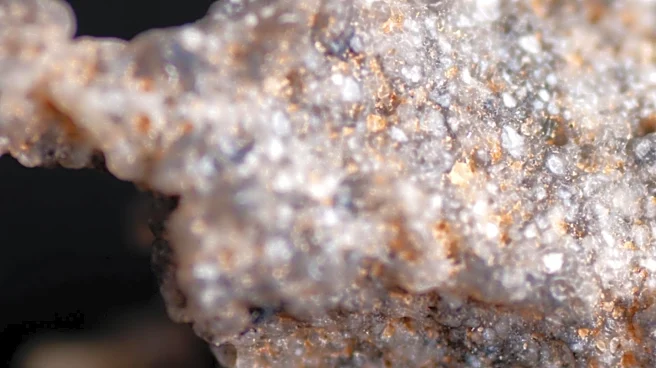
quartz, which defines true jasper, but rather a peralkaline igneous rock. This rock is primarily composed of feldspar (mesoperthite) and quartz, with the distinctive black spots identified as arfvedsonite, a sodium-iron amphibole, and minor hematite and epidote. Previously, these black spots were often misidentified as black tourmaline. The study, which utilized microscopy, Raman spectroscopy, and whole-rock chemistry, concluded that the material is most likely a microgranite, aplite, or rhyolite. Despite the scientific reclassification, the commercial name 'Dalmatian Jasper' remains widely used in the trade for beads, cabochons, and other jewelry items, particularly in the U.S. market. The primary source for this material is Chihuahua, Mexico.
Why It's Important?
This reclassification by the GIA holds significance for the U.S. gemstone and jewelry industry, impacting how materials are identified, marketed, and understood by both sellers and consumers. While 'Dalmatian Jasper' is a well-established commercial name, the scientific distinction to 'Dalmatian Stone' provides greater accuracy regarding its geological composition. This clarity can influence gemological education, appraisal practices, and potentially consumer confidence in product descriptions. For businesses, it necessitates careful labeling to comply with industry standards and consumer protection guidelines, such as the FTC Jewelry Guides, especially when differentiating between natural and dyed versions of the stone. The shift in understanding the mineral composition also affects the perceived properties and care recommendations for the stone, as its hardness and chemical reactions are tied to its actual mineral makeup rather than previous assumptions. This scientific rigor helps maintain transparency and integrity within the U.S. gemstone market.
What's Next?
Following the GIA's findings, the U.S. gemstone and jewelry trade will likely continue to navigate the use of both 'Dalmatian Jasper' and 'Dalmatian Stone' in commerce. Reputable sellers are encouraged to adopt more precise labeling, potentially using both terms or specifying the material's true composition to inform consumers accurately. Educational institutions and gemological laboratories in the U.S. will integrate this updated information into their curricula and identification processes. Consumers may see an increase in product descriptions that clarify the stone's geological nature, particularly for higher-value pieces or those sold by gemologically informed retailers. The ongoing use of 'Dalmatian Jasper' as a trade name is expected to persist due to its long-standing recognition, but the scientific community and discerning buyers will increasingly refer to it by its more accurate designation, 'Dalmatian Stone.'
Beyond the Headlines
The reclassification of Dalmatian Jasper highlights a broader trend in the U.S. gemstone industry towards greater scientific accuracy and transparency. This development underscores the importance of ongoing research in gemology to refine our understanding of natural materials. It also brings to light the tension between established commercial nomenclature and scientific precision. While commercial names often prioritize marketability and historical usage, scientific classifications provide a foundational understanding of a material's properties and origins. This dynamic can lead to ethical considerations for businesses regarding how they describe and market their products, particularly in an era where consumers are increasingly seeking authenticity and detailed information. The case of Dalmatian Jasper serves as a micro-example of how scientific discoveries can gradually reshape industry practices and consumer expectations, fostering a more informed and trustworthy marketplace for gemstones in the U.S.