




What's Happening?
Stellantis, the sole major automaker in Italy, is confronting substantial challenges in maintaining its production levels within the country. According to Emanuele Cappellano, the European head of Stellantis, increasing costs and heightened competition
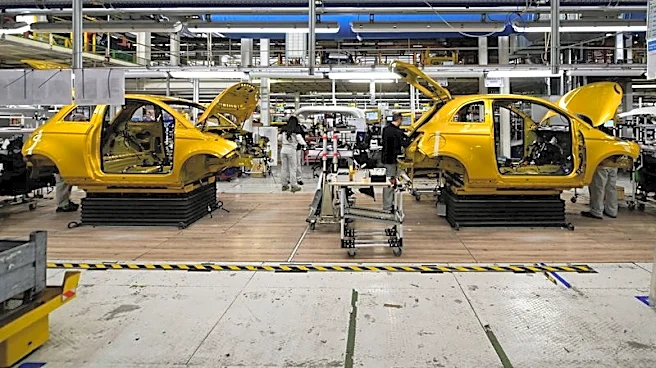
are making it a daily struggle to ensure continuous production. Despite a slight recovery this year, output remains significantly below historical levels, with 2025 seeing a 20% drop to approximately 380,000 vehicles, nearly half the volume produced in 2023. Cappellano highlighted that rising production costs are linked to current global conflicts, an increasingly competitive market due to rising vehicle imports, and the expenses associated with the transition to electric vehicles. Stellantis is investing over €5 billion in research and development in Italy over the next five years and plans to add nine new models by 2030, alongside spending more than €7 billion annually on local suppliers. However, Cappellano emphasized the need for greater cooperation among industry, government, and local authorities to address these complex issues.
Why It's Important?
The struggles faced by Stellantis in Italy have significant implications for the U.S. automotive industry and global supply chains. As a major international automaker, Stellantis's production challenges in one region can impact its overall manufacturing capacity and ability to meet demand in other markets, including the U.S. The rising costs of production, driven by global conflicts and the transition to electric vehicles, reflect broader economic pressures that could affect other multinational corporations with manufacturing operations in various countries. If these cost pressures persist or intensify, they could lead to higher vehicle prices for U.S. consumers or shifts in production strategies that prioritize lower-cost regions. Furthermore, the call for government support to curb energy costs and reduce red tape in Italy highlights the critical role of public policy in maintaining industrial competitiveness, a factor that U.S. policymakers also consider when attracting or retaining manufacturing jobs. The situation underscores the interconnectedness of the global automotive sector and how regional economic conditions can ripple across international markets.
What's Next?
Stellantis is actively engaged in discussions with European Union authorities to find pragmatic solutions that balance environmental goals with industrial needs. The company is urging the Italian government to focus on curbing energy costs and reducing bureaucratic hurdles to support local production. The outcome of these discussions and the effectiveness of any implemented support measures will be crucial in determining Stellantis's future production footprint in Italy. The company's commitment to investing over €5 billion in research and development and introducing new models by 2030 indicates a long-term strategy for the region, but its execution will depend on mitigating the current cost and competitive pressures. If these challenges are not adequately addressed, Stellantis might need to re-evaluate its production strategies, potentially leading to further reductions in output or shifts in manufacturing locations, which could have broader implications for the European and global automotive supply chains.
Beyond the Headlines
The challenges faced by Stellantis in Italy extend beyond immediate production figures, touching upon deeper economic and geopolitical currents. The mention of rising production costs linked to 'current global conflicts' points to the far-reaching economic consequences of international instability, impacting everything from energy prices to raw material availability. This situation highlights the vulnerability of globalized manufacturing to geopolitical events and the increasing need for companies to build resilience into their supply chains. Moreover, the 'electric transition' is identified as a significant cost driver, underscoring the immense financial and logistical hurdles involved in shifting from traditional internal combustion engine vehicles to electric ones. This transition is not merely a technological upgrade but a fundamental restructuring of industrial processes, requiring substantial investment in new infrastructure, research, and development. The call for government intervention to address energy costs and red tape also reflects a broader debate about industrial policy in an era of global competition and climate change, where governments are increasingly expected to play a role in supporting strategic industries.