


What's Happening?
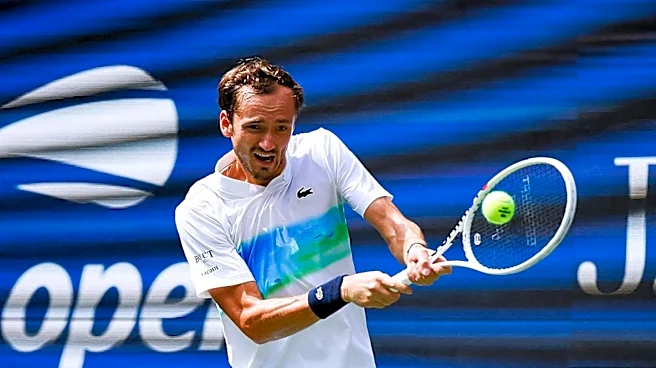
Tennis player Daniil Medvedev has voiced strong dissatisfaction with the court conditions at the Vienna Open, despite his current stellar form, which includes winning two titles and reaching three semi-finals in the past month. Following his victory over
Adrian Mannarino, Medvedev stated that, in his opinion, the court is 'not a good court' for an indoor hard court. He emphasized that his strong performance, winning 6-2, 6-3, did not change his view on the court's quality. Medvedev, known for openly expressing his displeasure with various aspects of tennis, including balls, conditions, and umpires, believes that indoor hard courts should favor serve and volley play, but the current conditions in Vienna would make such a strategy ineffective. He argued that diversifying conditions is understandable, but the Vienna Open's indoor hard court setup is 'just not right.'
Why It's Important?
Medvedev's critique highlights a recurring issue within professional tennis regarding court standardization and player welfare. His comments, coming from a top-ranked player, can draw significant attention to the playing conditions at various tournaments, potentially influencing future court surface decisions by event organizers. For players, inconsistent court conditions can impact their game, increase the risk of injury, and affect strategic approaches, as Medvedev noted regarding serve and volley play. For tournament organizers, such public criticism from high-profile athletes can affect their reputation and potentially their ability to attract top talent in the future. The debate over court conditions also touches upon the broader discussion of maintaining competitive fairness and ensuring optimal playing environments across the ATP Tour.
What's Next?
While Medvedev has officially secured his spot in the ATP Finals, his public comments about the Vienna Open courts may prompt discussions among tournament organizers and the ATP Tour regarding court specifications and consistency. It is unlikely that immediate changes will be made to the Vienna Open courts during the current tournament, but his feedback could contribute to long-term reviews of court surfaces for future events. Other players might echo similar sentiments, potentially leading to a more unified call for standardized or improved playing conditions. The incident also sets the stage for continued scrutiny of tournament conditions by players, especially as they navigate a demanding schedule and aim to perform at their best.
Beyond the Headlines
Medvedev's outspokenness reflects a growing trend among professional athletes to use their platform to advocate for better working conditions and fairness within their respective sports. This extends beyond just court surfaces to broader issues like the tennis calendar's organization, which Medvedev has also criticized in the past. Such athlete advocacy can empower other players to voice their concerns, potentially leading to more player-centric decision-making within sports governing bodies. It also underscores the tension between tournament organizers' desire for unique event characteristics and players' need for consistent, high-quality playing environments. This dynamic can shape the future landscape of professional tennis, influencing everything from tournament scheduling to venue design and player representation in decision-making processes.