




What's Happening?
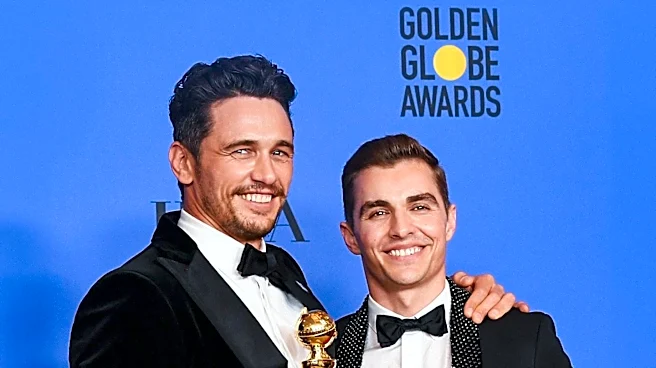
Actor Dave Franco has spoken out about the public perception of him being an "asshole," attributing this misconception to the villainous characters he frequently portrayed early in his career. During an appearance on the 'Happy Sad Confused' podcast,
Franco explained that his limited presence on social media has prevented the public from seeing his true personality. Consequently, people have largely formed opinions about him based solely on his on-screen roles. He noted that playing antagonists in films such as 'Hoppers,' 'Neighbors,' '21 Jump Street,' and 'Superbad' led many to assume his real-life demeanor mirrored these characters. Franco acknowledged that this resulted in people being "surprised" when they met him and found him to be pleasant. He hopes that through his extensive interview history, the public can now gain a more accurate understanding of who he is as a person, separate from his fictional roles.
Why It's Important?
This situation highlights the significant impact that an actor's on-screen roles can have on their public image, particularly in an era where social media often dictates celebrity-fan interaction. For actors like Franco, who choose to limit their social media presence, the distinction between their professional characters and personal identity can become blurred in the public eye. This can lead to misjudgments and preconceived notions that affect their personal and professional lives. The phenomenon underscores the power of media representation and the challenges actors face in managing their public persona, especially when their roles are consistently typecast. It also raises questions about how audiences consume and interpret celebrity identities, often conflating fictional portrayals with reality, and the potential for such misinterpretations to influence career opportunities and public engagement.
What's Next?
Franco's continued efforts to clarify his public image through interviews suggest a strategic approach to reshape how he is perceived. By openly discussing the disconnect between his roles and his true self, he aims to foster a more authentic connection with his audience. This could lead to a broader range of roles being offered to him, moving beyond the "villainous" typecasting that defined his early career. His willingness to address these perceptions publicly may also encourage other actors to be more transparent about the challenges of maintaining a distinct personal identity in the entertainment industry. Furthermore, this discussion could prompt a wider conversation within the industry about the responsibility of media in shaping public perception and the potential for typecasting to unfairly label individuals.
Beyond the Headlines
The deeper implication of Franco's experience touches upon the broader societal tendency to conflate fictional characters with the real individuals who portray them. This issue extends beyond the entertainment industry, affecting public figures in various fields. It raises ethical questions about the nature of celebrity and the public's right to an individual's private life versus their public persona. The absence of social media, which for many celebrities serves as a direct channel to control their narrative, left Franco's public image largely at the mercy of his on-screen portrayals. This situation underscores the psychological impact of public perception on individuals and the constant negotiation between an artist's work and their personal identity. It also highlights the evolving landscape of celebrity culture, where authenticity and direct engagement are increasingly valued, yet often difficult to achieve when past roles cast long shadows.