






What's Happening?
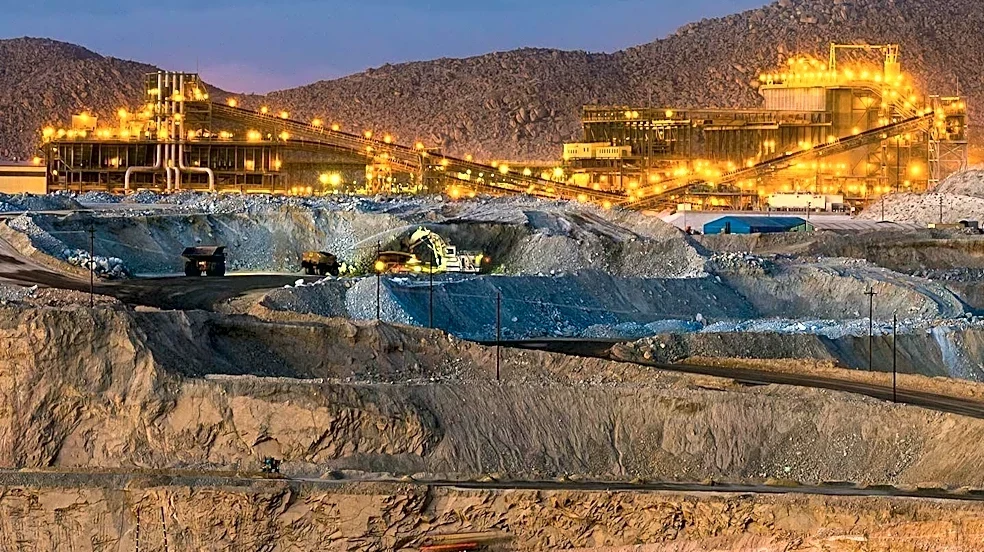
Antofagasta, a major copper producer, has revised its 2026 cash-cost forecast before by-product credits, indicating a 6% increase at the midpoint. The company now anticipates costs to be between US$2.60 and US$2.70 per pound, up from the previous US$2.40
to US$2.60. This adjustment comes despite an improvement in the third quarter, where cash costs before by-product credits decreased by 7% to US$2.73 per pound. The annual copper production guidance remains unchanged at 625,000 to 655,000 tonnes, and the net cash-cost guidance also holds steady at US$1.15 to US$1.35 per pound. The distinction between gross and net cost forecasts is crucial, as by-product credits play a significant role in offsetting the underlying operational expenses. The company's October 15 regulatory production report highlights that while recent operating performance improved, it was insufficient to maintain the earlier full-year gross-cost forecast.
Why It's Important?
This cost outlook revision by Antofagasta signals a broader trend of increasing operational expenses within the copper mining sector. For U.S. industries reliant on copper, such as manufacturing, construction, and electronics, this could translate into higher raw material costs. The unchanged net-cost forecast, however, suggests that the company expects to mitigate some of these rising gross costs through by-product revenues, preventing a direct translation into reduced profits. This situation underscores the importance for mining executives and investors to analyze both gross and net cost figures to gain a complete understanding of a company's financial health and operational efficiency. The revision also highlights that stable production guidance does not necessarily equate to stable mining economics, as underlying costs can fluctuate independently. This could influence investment decisions and supply chain strategies for U.S. companies engaged in copper-intensive activities.
What's Next?
The immediate focus will be on Antofagasta's ability to meet its revised gross-cost range and unchanged production targets by the end of 2026. Future operating reports will clarify whether the third-quarter cost improvements continue, impacting the annual outcome. The explanation of by-product credits will be critical in understanding how the company maintains its net-cost forecast despite rising gross expenses. Stakeholders, including investors and industry analysts, will closely monitor upcoming financial statements to differentiate between unit-cost movements, total spending, and cash generation. The broader copper sector will also be watching to see if this trend of increasing gross costs, offset by by-product credits, becomes more widespread, potentially leading to adjustments in pricing strategies and supply chain management across the industry.
Beyond the Headlines
The divergence between rising gross costs and stable net costs in Antofagasta's forecast reveals a deeper complexity in mining economics. It emphasizes that by-product credits are not merely supplementary income but a fundamental component of cost management in the extractive industries. This dynamic could lead to increased strategic focus on optimizing by-product recovery and sales across the mining sector. Furthermore, the situation highlights the ongoing challenge for companies to maintain profitability and investor confidence amidst fluctuating operational costs and market demands. The need for transparent reporting that clearly distinguishes between various cost measures will become even more critical for stakeholders to accurately assess a company's true financial performance and long-term sustainability in a volatile global market.