
What's Happening?
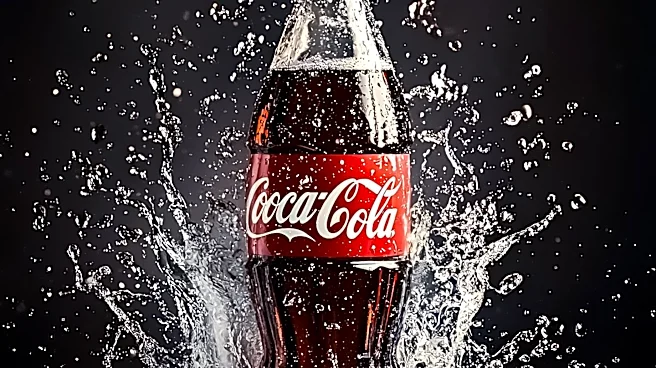
The Coca-Cola Company (KO) has shown strong stability and momentum in the beverage sector, with its stock rising approximately 11% over the past month and nearing a 52-week high. This performance follows
solid third-quarter results, which saw revenue increase by roughly 7%, global unit case volume up 5%, and comparable EPS growth near 11%. Management has raised its full-year guidance for the third consecutive time and secured the KFC U.S. beverage account starting in 2027. Investors are increasingly viewing Coca-Cola as a defensive holding amidst tech volatility, supported by its consistent dividend and 'Dividend King' status. In contrast, Monster Beverage Corporation (MNST), while showing strong top-line growth, experienced a sharp stock decline after its latest report due to slower profit growth, contracting gross margins from higher input costs, and regulatory uncertainty.
Why It's Important?
This divergence in performance between Coca-Cola and Monster Beverage highlights a significant shift in investor sentiment within the U.S. beverage sector. In times of market volatility, investors are prioritizing stability, predictable cash flow, and defensive holdings, which Coca-Cola's diversified concentrate business and dividend yield offer. This trend suggests that established, resilient companies with strong market positions are favored over high-growth, more volatile entities, especially when facing cost pressures and regulatory scrutiny. For the broader U.S. economy, Coca-Cola's continued strength indicates consumer resilience in staple goods, while Monster's challenges reflect the impact of rising input costs like aluminum on companies with less diversified portfolios. The securing of the KFC U.S. account further solidifies Coca-Cola's market dominance in the food service industry.
What's Next?
Coca-Cola is expected to maintain its steady growth trajectory, driven by its pricing power, scale, and continued strategic partnerships like the KFC U.S. beverage account. Investors will likely continue to view it as a safe haven amidst ongoing market uncertainties. For Monster Beverage, the focus will be on addressing margin pressures, managing input costs, and resolving regulatory inquiries to regain investor confidence. The beverage sector as a whole may see other companies adjust their strategies, potentially emphasizing cost control, supply chain resilience, and diversified product portfolios to mitigate risks. The ongoing competition between established giants and growth-focused brands will continue to shape market dynamics, with a potential lean towards stability in the near term.
Beyond the Headlines
The contrasting fortunes of Coca-Cola and Monster Beverage underscore a deeper economic narrative about the current investment climate. The preference for 'Dividend Kings' like Coca-Cola reflects a broader risk-off sentiment, where capital preservation and consistent returns are prioritized over aggressive growth. This could have long-term implications for how companies are valued and how investment portfolios are constructed, potentially leading to a re-evaluation of growth stocks versus value stocks. Furthermore, the impact of input costs on Monster Beverage highlights the fragility of supply chains and the importance of operational efficiency in a globalized economy. The regulatory inquiry faced by Monster also points to increasing scrutiny on product labeling and corporate practices, which could lead to stricter industry standards and greater compliance burdens for beverage companies in the U.S. and internationally.