






What's Happening?
Deere & Co. (DE) stock has recently reached an all-time high, with financial analysts identifying it as a 'double AI beneficiary.' This designation stems from two primary factors: the ongoing infrastructure buildout driving demand for its construction
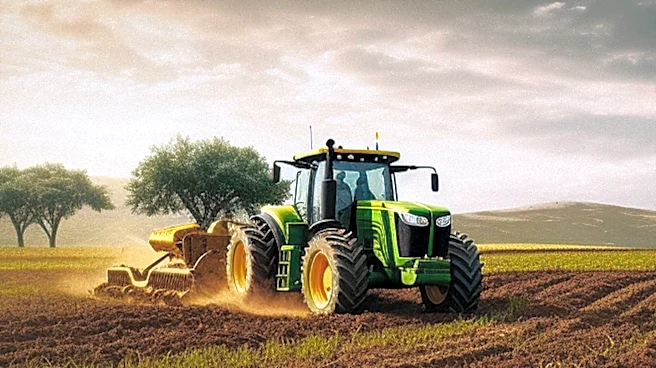
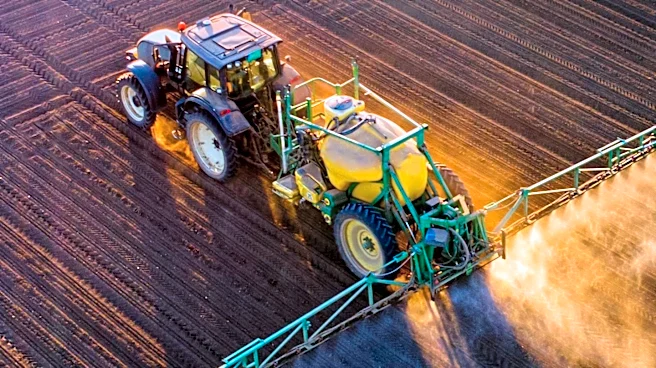
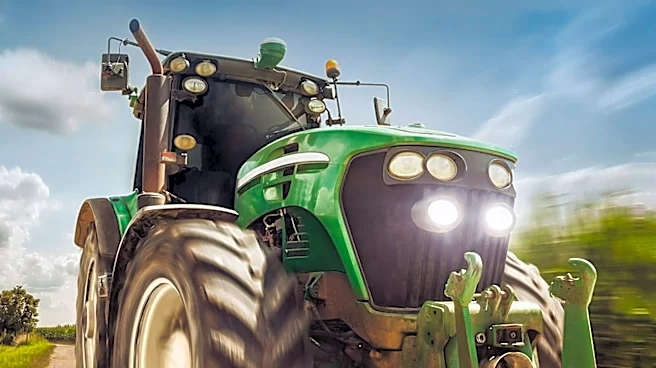
and industrial equipment, and the company's advanced deployment of AI technology within its agricultural machinery. Deere's 8R tractor operates fully autonomously, navigating and working fields without an operator. Additionally, its 'See & Spray' technology utilizes computer vision to differentiate weeds from crops, significantly reducing herbicide costs by over 50%. This technology is already being scaled, with factory-installed sprayer orders doubling year over year and approximately one-third of North American sprayer orders for 2027 including this feature. The company's AI capabilities are a result of strategic acquisitions, including Blue River Technology in 2017 for $305 million and Bear Flag Robotics in 2021 for $250 million. Despite fiscal 2026 being projected as the bottom of the cycle by management, investors are showing confidence, pushing the stock to new highs.
Why It's Important?
The performance of Deere & Co. highlights a significant trend in the industrial and agricultural sectors: the increasing integration and value of artificial intelligence. Deere's success demonstrates how traditional industries can leverage AI to enhance efficiency, reduce operational costs, and create new market advantages. The 'See & Spray' technology, for instance, not only offers substantial cost savings for farmers but also contributes to more sustainable agricultural practices by minimizing chemical usage. This innovation positions Deere as a leader in precision agriculture, potentially influencing competitors to accelerate their own AI adoption. The stock's rise, even as the agricultural cycle bottoms, indicates investor recognition of the long-term growth potential driven by technological innovation rather than just cyclical market conditions. This could encourage further investment in companies that effectively merge industrial operations with advanced AI solutions, impacting the broader U.S. manufacturing and technology investment landscape.
What's Next?
Deere & Co. is expected to continue scaling its AI-driven technologies, such as the 'See & Spray' system and autonomous tractors, which will likely further solidify its market position. The company's management has projected fiscal 2026 as the bottom of the agricultural cycle, suggesting potential for future growth as the cycle recovers. Analysts like Baird have upgraded the stock to 'Outperform' and raised price targets, anticipating an agricultural inflection point driven by rising corn and soybean futures. Investors will be closely watching for continued adoption rates of Deere's advanced technology and how these innovations translate into future earnings reports. The company's ability to maintain its technological lead and integrate AI into a broader range of products will be crucial for sustaining its growth trajectory and investor confidence. Potential reactions from competitors may include increased R&D in AI and automation to keep pace with Deere's advancements.
Beyond the Headlines
Deere's successful integration of AI into heavy machinery signals a broader transformation across industrial sectors, moving beyond mere automation to intelligent, autonomous operations. This shift has profound implications for labor markets, potentially redefining roles for agricultural and construction workers as machines take on more complex tasks. Ethically, the widespread adoption of autonomous farming equipment raises questions about data privacy, as these machines collect vast amounts of field-specific data, and the potential for technological dependence in food production. Legally, the regulatory framework for autonomous vehicles in agriculture is still evolving, which could present challenges or opportunities for companies like Deere. Culturally, it represents a significant evolution in how society views agriculture, from a labor-intensive industry to one driven by high-tech solutions, potentially attracting a new generation of tech-savvy professionals to the sector and reshaping rural economies.