




What's Happening?
Dell Technologies is currently managing a substantial backlog of $132.3 billion in AI server orders as of October. The company, led by CEO Michael Dell, has implemented a rigorous vetting process for specialist cloud providers, requiring them to present
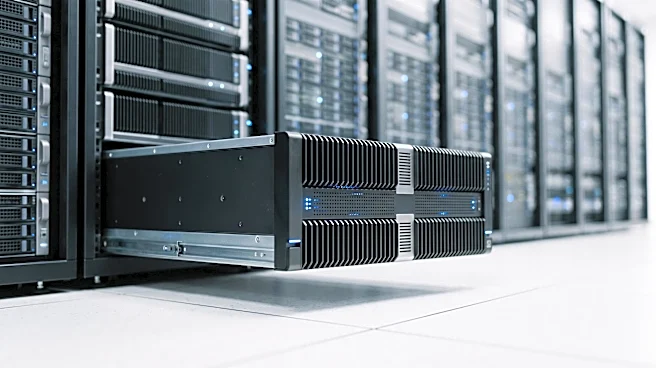
customer contracts before Dell agrees to supply AI servers. This measure ensures that buyers have access to necessary capital, land, and power for these large installations. Dell's Vice Chairman and Chief Operating Officer, Jeff Clarke, stated on a November 24 earnings call that the company tests server racks before shipment and can get them operational within six hours of delivery, potentially accelerating AI model output by four to six weeks compared to competitors. This efficiency is crucial for cloud providers, as earlier online operation translates to increased revenue. Dell reported record quarterly revenue of $54.9 billion, a 103% increase from the previous year, with AI-optimized servers contributing $22 billion, marking a 291% rise. The company has also updated its full-year guidance for AI server revenue to $78 billion.
Why It's Important?
This significant backlog and Dell's strategic approach to fulfilling AI server orders highlight the booming demand for AI infrastructure within the U.S. and globally. The stringent vetting process for customers, particularly requiring proof of capital, land, and power, underscores the massive investment and logistical challenges associated with deploying large-scale AI operations. For cloud providers, Dell's ability to expedite server deployment by several weeks offers a substantial competitive advantage, allowing them to monetize their AI models faster. This efficiency can lead to higher profitability for these providers, even if it involves additional charges from Dell. The financial performance of Dell Technologies, with its record revenue and increased profitability in its Infrastructure Solutions Group, indicates a strong market position in the rapidly expanding AI sector. The company's focus on operational efficiency, as noted by CFO David Kennedy, is driving higher profitability despite rising expenses, demonstrating a successful strategy in a high-demand environment.
What's Next?
Dell Technologies will focus on converting its $132.3 billion AI server backlog into sustained cash flow, a process that will span several quarters and nearly 100 installation sites, each requiring power and cooling infrastructure. The company's ability to maintain its accelerated deployment schedule will be critical for customer satisfaction and continued market leadership. While no customers have requested rescheduling, potential challenges include managing the supply chain for expensive components, as indicated by a 182% increase in inventory to $29.44 billion. Dell's reliance on a relatively small number of large customers and cloud service providers for most of its AI server revenue suggests that maintaining strong relationships and potentially offering short-term financing will be key. The company's partnerships with entities like Eli Lilly, Samsung Electronics, and Honeywell Technologies demonstrate ongoing collaboration in the AI space, which could lead to further orders and technological advancements.
Beyond the Headlines
The immense demand for AI servers, as evidenced by Dell's backlog, points to a broader societal and economic shift towards AI-driven technologies. The requirement for significant capital, land, and power for AI installations raises questions about infrastructure development, energy consumption, and environmental impact. The concentration of AI server revenue among a few large customers and cloud service providers could lead to increased market consolidation in the AI infrastructure sector, potentially creating barriers for smaller players. Furthermore, the rapid deployment capabilities highlighted by Dell could accelerate the pace of AI innovation and adoption across various industries, from healthcare to manufacturing. The ethical implications of widespread AI deployment, including data privacy, algorithmic bias, and job displacement, will become increasingly prominent as these technologies become more integrated into daily life and business operations.