





What's Happening?
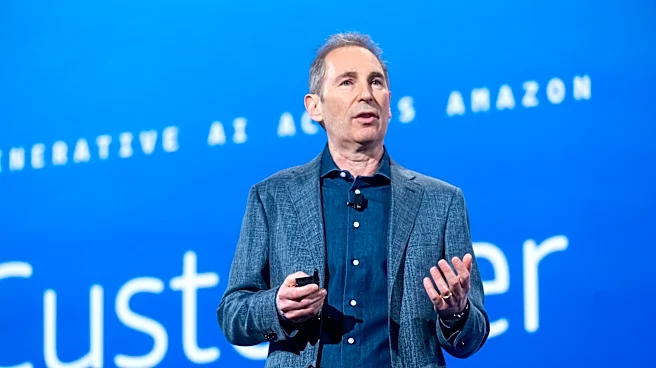
Six Amazon insiders, including CEO Andy Jassy, CFO Brian Olsavsky, and AWS CEO Matt Garman, collectively sold 64,848 shares of Amazon stock worth approximately $16.6 million. These sales occurred on November 24, 2026, and were executed under Rule 10b5-1
trading plans. A Rule 10b5-1 plan is a pre-arranged selling schedule that allows company insiders to sell shares without making day-to-day decisions, thereby avoiding accusations of insider trading. The sales took place after restricted stock units, which are shares promised as compensation, vested on November 21. For instance, CEO Andy Jassy exchanged 50,000 units and sold 20,000 shares in multiple transactions, totaling about $5.13 million. The average selling price for all transactions was roughly $256 per share. Amazon's stock saw a 3.47% increase to $255.39 on November 23, the day before most sales, and then a 1.21% decrease to $252.29 on November 24.
Why It's Important?
The sale of a significant amount of stock by top executives often raises concerns among investors, as it can be perceived as a lack of confidence in the company's future performance. However, the fact that these sales were conducted under Rule 10b5-1 trading plans is crucial. These pre-scheduled plans are designed to allow insiders to diversify their portfolios or manage personal finances without implying any negative outlook on the company. This transparency mechanism helps to mitigate potential market overreactions that might occur if sales were made ad-hoc. For Amazon, a company with a market capitalization of $2.73 trillion, these sales represent a routine part of executive compensation and financial planning rather than a red flag. The consistent pattern of sales following the vesting of restricted stock units, as noted with CEO Jassy, further reinforces this interpretation, suggesting a predictable financial management strategy by the executives.
What's Next?
Investors will likely continue to monitor future Form 4 filings for Amazon executives to ensure that sales remain within the established patterns of Rule 10b5-1 plans and are tied to the vesting of restricted stock units. Any deviation from this pattern, such as sales outside of a pre-set plan or beyond newly vested stock, could signal a shift in executive sentiment and potentially impact investor confidence. However, as long as these sales continue to align with pre-determined schedules and compensation structures, they are unlikely to trigger significant market concern. The company's stock performance will continue to be influenced by broader market trends, its financial results, and strategic announcements, rather than these routine insider transactions.
Beyond the Headlines
The use of Rule 10b5-1 trading plans by corporate executives highlights a broader effort to balance executive compensation with regulatory compliance and market transparency. While these plans are intended to prevent insider trading, they have also faced scrutiny regarding their potential for abuse, with some critics arguing that executives can still time their plans to their advantage. However, in this instance, the consistent and pre-scheduled nature of the sales by Amazon executives suggests adherence to the spirit of the rule. This practice underscores the complex interplay between executive compensation, personal financial planning, and the need for public trust in corporate governance. It also reflects the common practice in large corporations where a significant portion of executive compensation is tied to company stock, necessitating structured methods for liquidation.