







What's Happening?
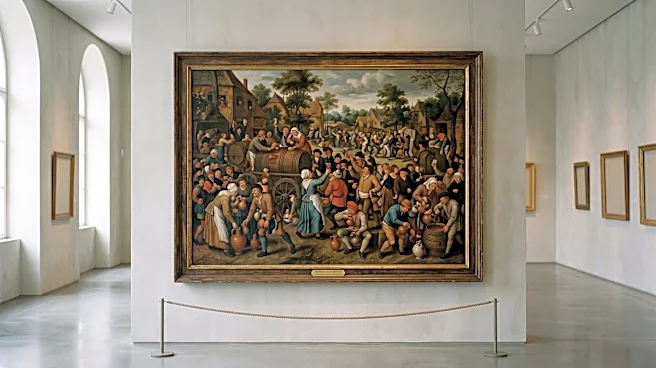
Pieter Bruegel the Elder's monumental painting, 'The Wine of Saint Martin's Day' (c. 1565-68), is his largest surviving work, measuring 148 by 270.5 centimeters. This glue-size tempera on fine linen piece depicts a lively scene of peasants celebrating
Martinmas, the feast day of Saint Martin, on November 11. The painting captures the bacchanalian atmosphere of the end of the harvest season, particularly the grape harvest, when new wine was sampled. A large crowd of peasants is shown scrambling over an enormous barrel, eager to fill their vessels with wine. Amidst this revelry, Saint Martin himself is depicted on the far right edge, almost unnoticed, cutting his cloak for beggars. A roadside cross stands nearby, largely ignored by the festive crowd. Bruegel's portrayal suggests that by the 1560s, the feast day had overshadowed the saint's religious significance, reflecting how the day was truly lived by the populace.
Why It's Important?
Bruegel's 'The Wine of Saint Martin's Day' is significant for its detailed portrayal of 16th-century European peasant life and cultural practices. The painting offers a valuable historical document, illustrating the customs associated with Martinmas, such as the sampling of new wine, the roasting of geese, and the slaughter of pigs for winter. It highlights the social dynamics and priorities of the time, where communal celebration and indulgence often took precedence. The subtle inclusion of Saint Martin's act of charity, almost lost within the boisterous crowd, provides a commentary on the evolving relationship between religious observance and secular festivities. This work contributes to understanding the broader cultural shifts in Europe during the Renaissance, where traditional religious holidays began to incorporate more secular and celebratory elements, reflecting the daily lives and concerns of ordinary people.
What's Next?
While 'The Wine of Saint Martin's Day' is a historical artwork, its continued study and exhibition contribute to ongoing art historical discourse and public appreciation of Renaissance art. Future analyses may delve deeper into Bruegel's social commentary, his use of composition to convey narrative, and the painting's place within the broader context of his oeuvre and the Northern Renaissance. The painting's size and detail make it a subject of continuous scholarly interest, potentially leading to new interpretations of its themes and techniques. As art conservation techniques advance, there may also be future opportunities for further restoration or technical studies to uncover more about Bruegel's artistic process and the materials he used.
Beyond the Headlines
Beyond its immediate depiction of a feast, 'The Wine of Saint Martin's Day' offers deeper insights into the human condition and societal values. Bruegel's choice to marginalize the saint's charitable act within a scene of widespread revelry can be interpreted as a critique of societal priorities, where spiritual duties might be overlooked in favor of earthly pleasures. This subtle commentary on human nature—the tendency to prioritize immediate gratification over altruism—remains relevant. The painting also exemplifies Bruegel's mastery in capturing the essence of everyday life, transforming ordinary scenes into profound observations on humanity. It underscores the enduring power of art to reflect, question, and preserve cultural narratives, providing a window into the past that continues to resonate with contemporary audiences regarding themes of community, celebration, and human morality.