







What's Happening?
India's crude oil imports decreased in August, with a notable decline in the share of Russian oil. Total crude imports fell to 4.7 million barrels per day (b/d) from 5.05 million b/d in July. This reduction is attributed to several factors, including
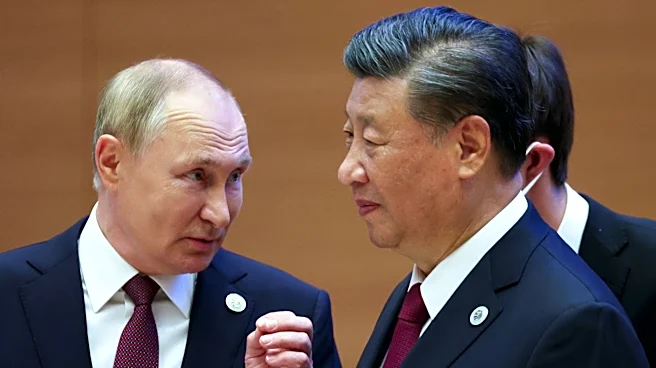
increased security risks in the Black Sea due to Ukrainian drone attacks, which have impacted Russian export terminals like Novorossiysk. Additionally, China is intensifying its competition for available Russian crude cargoes, with its Russian imports rising to 1.7 million b/d in August from 1.4 million b/d in July. This has led to more Urals crude being diverted to China. Consequently, Russian crude is becoming scarcer and more expensive for Indian refiners, trading at parity with dated Brent, eliminating the previous discount.
Why It's Important?
The diminishing availability and rising cost of Russian oil for India have significant implications for global energy markets and U.S. economic interests. As India, a major global oil consumer, seeks alternative suppliers, it increases demand and potentially prices for crude from other regions, including the Middle East and Latin America. This shift can contribute to global oil price volatility, which directly impacts U.S. consumers through gasoline prices and U.S. industries reliant on energy. The increased competition from China for Russian barrels also highlights the complex dynamics of international energy security and geopolitical alliances. For the U.S., this situation could influence its strategic energy partnerships and trade policies, as it navigates a global landscape where major economies are vying for stable and affordable energy supplies. The disappearance of discounted Russian oil means higher input costs for refiners, which can translate to higher prices for refined products globally.
What's Next?
India is actively diversifying its crude oil supply base in response to the challenges with Russian oil. Shipments from the UAE increased in August, and Iraq and Kuwait are gradually re-entering the Indian market. More distant producers like Brazil and Venezuela are also contributing to India's supply. This diversification strategy is expected to continue as India seeks to mitigate its vulnerability to single-source dependencies and geopolitical disruptions. However, September is anticipated to be a difficult month for crude buyers, with Asian fuel margins remaining high and continued instability around Middle Eastern maritime chokepoints. The long-term trend suggests that Russian barrels may become consistently scarcer and costlier, pushing Indian refiners to secure supplies from other regions at potentially higher costs. This could lead to sustained pressure on global oil prices and continued efforts by major economies to secure diverse energy sources.
Beyond the Headlines
The shift in India's oil procurement strategy extends beyond immediate economic concerns, touching upon broader geopolitical realignments. The reduced reliance on Russian oil, even if driven by market forces and security risks, could subtly alter the energy dynamics between India, Russia, and China. It underscores the limitations of relying on discounted oil from sanctioned nations, as market forces and logistical challenges eventually erode such advantages. This situation also highlights the growing importance of maritime security, particularly in the Black Sea and around Middle Eastern chokepoints, as threats to shipping can significantly disrupt global trade and energy flows. The strategic decisions made by countries like India in securing their energy needs will have ripple effects on international relations, trade agreements, and the global energy transition, potentially accelerating investments in alternative energy sources and more resilient supply chains.