




What's Happening?
Farmers across the U.S. are increasingly relying on decades-old machinery, including John Deere equipment, due to a challenging agricultural economy. High fertilizer and fuel costs, coupled with a projected decline in farm income for the current year,
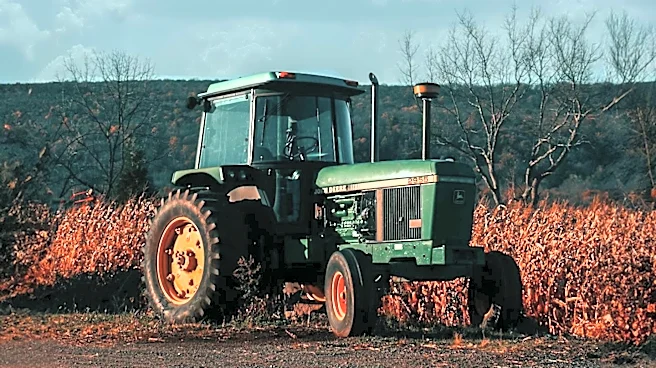
are making it difficult for farmers to afford new equipment. For instance, Dennis Kellogg, a sixth-generation farmer, utilizes a 1970s John Deere combine and a 2003 John Deere tractor, which is his newest. He prides himself on his ability to repair and adapt older parts, often acquiring equipment at scrap prices to perform tasks that new machinery costing tens of thousands of dollars would. This trend is reflected in industry data, with combine sales dropping 50% and tractor sales falling 20% compared to the previous year, according to the Association of Equipment Manufacturers. While some farmers, like Kellogg, are adept at maintaining older machines, others are exploring alternatives such as hiring custom harvesting services to avoid the significant capital investment in new equipment.
Why It's Important?
The widespread reliance on older farm machinery has significant implications for the U.S. agricultural sector and related industries. For farmers, it represents a strategic adaptation to economic pressures, allowing them to reduce overhead costs and maintain profitability in a tight market. However, it also highlights the financial strain on the agricultural community, potentially hindering technological adoption and efficiency gains that newer equipment could offer. For manufacturers like John Deere, this trend signifies a slowdown in new equipment sales, impacting their revenue and potentially influencing their research and development investments. The increased demand for spare parts and repair services for older models could create new opportunities for aftermarket businesses and skilled mechanics. Furthermore, this situation underscores the broader economic challenges facing rural America, where farmers are making difficult choices to sustain their livelihoods amidst rising input costs and fluctuating commodity prices.
What's Next?
As the tough farm economy persists, it is anticipated that more farmers will continue to prioritize cost-saving measures, including the maintenance and repair of existing older machinery. This could lead to a sustained demand for parts and specialized repair services for vintage farm equipment. Industry experts suggest that farmers will increasingly evaluate the cost-benefit of new technologies, with some opting for targeted upgrades like drones for specific tasks, rather than full-scale equipment replacements. The U.S. Department of Agriculture's projections for declining farm income indicate that the financial pressures on farmers are unlikely to ease in the immediate future, reinforcing the need for innovative solutions and cost-effective practices. Additionally, the discussion around right-to-repair legislation may gain further traction as farmers seek greater autonomy in maintaining their equipment, potentially influencing future policies regarding agricultural machinery and digital tools.
Beyond the Headlines
The reliance on older John Deere machinery extends beyond immediate economic concerns, touching upon themes of sustainability, self-sufficiency, and the evolving relationship between farmers and technology. By repairing and repurposing older equipment, farmers like Dennis Kellogg are embodying a form of practical sustainability, reducing waste and extending the lifespan of valuable assets. This approach contrasts with the rapid technological cycles often seen in other industries. It also highlights a cultural aspect of farming, where mechanical aptitude and resourcefulness are highly valued skills. The debate over the 'right to repair' becomes particularly salient in this context, as farmers seek to maintain control over their tools and avoid dependence on manufacturers for costly repairs or proprietary software. This situation could also spur innovation in retrofitting older machines with modern components, bridging the gap between legacy equipment and contemporary agricultural demands, and fostering a more resilient and adaptable farming community.