





What's Happening?
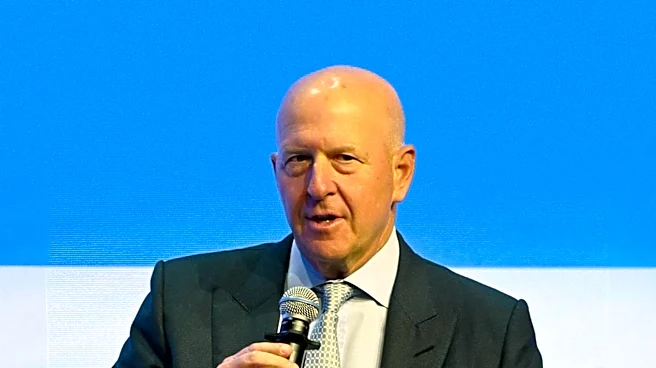
Goldman Sachs CEO David Solomon anticipates that advancements in Artificial Intelligence (AI) will lead to extended human lifespans and improved health, consequently causing people to remain in the workforce for longer periods. In a recent interview with
NBC News, Solomon expressed his enthusiasm for AI's potential in health and longevity, noting that work provides individuals with a sense of purpose beyond just income. He emphasized that managing AI's societal impact is a shared responsibility, requiring cooperation between governments and private companies. This collaboration is crucial for developing policies and support systems for workers during potential labor force disruptions caused by rapid technological progress. Solomon also highlighted the importance of allowing innovation in AI development while ensuring companies are held accountable for its effects. He believes both public and private sector leaders must work together to leverage AI for solving problems like disease, while simultaneously mitigating associated risks.
Why It's Important?
This perspective from a prominent financial leader like David Solomon signals a potential long-term shift in workforce dynamics and economic planning. If AI significantly extends healthy lifespans, it could challenge existing retirement frameworks, social security systems, and healthcare models. The notion that individuals will work longer due to improved health and a desire for purpose suggests a re-evaluation of career paths, lifelong learning, and the role of work in society. For businesses, this could mean a more experienced and potentially older workforce, necessitating changes in workplace design, training programs, and benefits. Governments would face pressure to adapt policies related to retirement age, pension funds, and labor laws to accommodate a demographic that remains economically active for a longer duration. The emphasis on corporate accountability for AI's impact also underscores growing concerns about ethical AI development and its broader societal implications, particularly regarding job displacement and economic inequality.
What's Next?
The implications of AI-driven longevity and extended work lives will likely prompt ongoing discussions among policymakers, economists, and business leaders. We can anticipate increased focus on developing flexible work arrangements, reskilling initiatives, and new models for retirement planning that account for longer careers. Governments may explore adjustments to social security and Medicare eligibility ages, while companies might invest more in employee wellness programs and age-inclusive workplace strategies. Furthermore, the call for cooperation between the public and private sectors on AI governance suggests a push for regulatory frameworks that balance innovation with societal protection. This could lead to new legislation or industry standards aimed at ensuring responsible AI development and deployment, particularly concerning its impact on employment and worker transitions. Public discourse will also likely intensify around the ethical considerations of AI in healthcare and its potential to exacerbate existing inequalities if access to these life-extending technologies is not equitable.
Beyond the Headlines
Solomon's vision extends beyond mere economic projections, touching upon fundamental aspects of human existence and societal structure. The idea that work provides 'purpose' suggests a deeper philosophical shift where employment is not solely a means to an end but an integral part of well-being throughout an extended lifespan. This could lead to a redefinition of 'retirement' from a complete cessation of work to a transition into different forms of engagement or reduced hours. Ethically, the prospect of significantly extended lifespans raises questions about resource allocation, intergenerational equity, and the potential for new forms of social stratification based on access to advanced health technologies. Legally, intellectual property rights for AI-driven medical innovations and liability for AI-related health outcomes will become critical areas of development. Culturally, a society where people work into their 80s or 90s could reshape family structures, educational systems, and leisure activities, fostering a continuous learning environment and blurring traditional life stages.