







What's Happening?
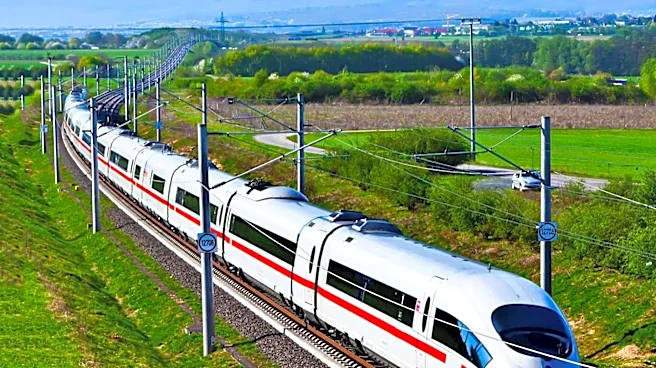
The European Union's high-speed rail network reached 12,015 kilometers in 2022, constituting 6% of the total rail network. High-speed trains accounted for approximately one-third of the 402.2 billion passenger-kilometers recorded across the EU. The market
is predominantly led by Italy, France, and Spain, which collectively represent 63% of the network and about two-thirds of European high-speed traffic. While the European rail network has historically been national, there is a growing trend of cross-border competition. The development of the Trans-European Transport Network (TEN-T) corridors is underway, with projects like the Turin-Lyon line highlighting the complexities and challenges involved in expanding this infrastructure. The first high-speed line in Europe was inaugurated in 1981 between Paris and Lyon, setting a precedent for an industrial and commercial model that allowed high-speed trains to also operate on conventional lines, extending their reach.
Why It's Important?
The expansion and increasing competition within the European high-speed rail sector signify a significant shift in the continent's transportation landscape. This development fosters greater connectivity between European nations, potentially reducing travel times and promoting economic integration. The liberalization of national high-speed rail markets, as seen in Italy in 2012 and more recently in Spain and France, introduces new operators and intensifies competition. This can lead to improved services, lower fares for passengers, and increased efficiency across the network. For instance, in Italy, demand more than doubled in the first eight years of competition, while average revenue per passenger-kilometer decreased. The entry of new players like Italo into the German market and Velvet in France indicates a future where national monopolies are challenged, pushing for innovation and better value for consumers. This competitive environment could also influence investment in new infrastructure and technology, further advancing high-speed rail capabilities.
What's Next?
The European high-speed rail market is poised for further liberalization and increased competition. Operators like Italo plan to launch services in Germany by 2028, investing 3.6 billion euros and ordering 26 high-speed trains. Similarly, Velvet, a private French operator, aims to begin services on the Paris–Bordeaux route in 2028, with plans to expand further. These developments suggest a future where national rail champions will face more challengers on their home turf. There are also predictions of SNCF entering the Italian market by 2028 and new competitors emerging on the Paris–London route around 2030. The ongoing development of the TEN-T corridors, despite challenges like the Turin–Lyon line, indicates a continued commitment to building a more integrated European rail network. This will likely lead to more cross-border services and a more interconnected continent for travelers and businesses.
Beyond the Headlines
The evolution of Europe's high-speed rail network extends beyond mere transportation, touching upon broader themes of European integration and economic policy. The shift from national monopolies to a competitive, cross-border market reflects a deeper commitment to the principles of the European single market, aiming to break down barriers and foster greater economic cohesion. This trend could serve as a model for other sectors within the EU, demonstrating the benefits of liberalization in terms of consumer choice and service quality. Furthermore, the emphasis on high-speed rail aligns with environmental goals, offering a more sustainable alternative to air travel for inter-city connections. The challenges in developing ambitious projects like the Turin–Lyon line also highlight the complexities of coordinating large-scale infrastructure across multiple nations, involving diverse political, economic, and environmental considerations. The success of this integrated rail system could significantly influence future European policy on infrastructure development and cross-border cooperation.