





What's Happening?
Vulture film critic Alison Willmore has reviewed 'Whalefall,' a new movie based on Daniel Kraus's 2023 novel, co-written and directed by Brian Duffield. The film stars Austin Abrams as Jay Gardiner, a young man who gets swallowed whole by a sperm whale
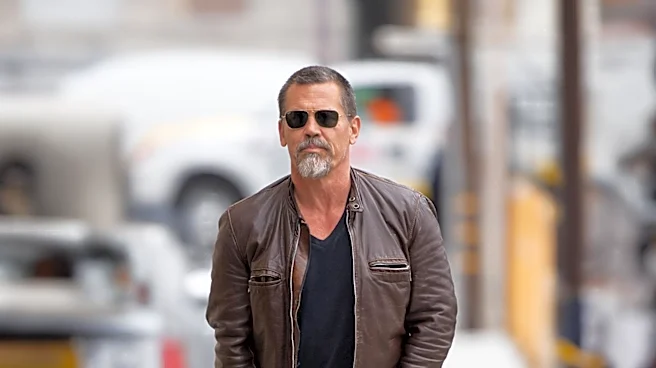
while attempting to recover his deceased father's remains. The review highlights the film's dual narrative: a survival thriller set inside the whale's stomach and a family drama exploring grief and a strained father-son relationship. Jay's father, Mitt (played by Josh Brolin), is depicted as a grizzled sea dog with whom Jay had a difficult relationship, marked by Mitt's relentless push for Jay to conform to his image. The critic notes that while Abrams delivers a plausible performance in the claustrophobic whale interiors, the film struggles to seamlessly intertwine its high-concept premise with its emotional themes, often making the father-son conflict feel archetypal.
Why It's Important?
The review of 'Whalefall' underscores a growing trend in contemporary cinema where high-concept premises are used to explore deeper psychological or societal themes. By explicitly framing the whale as a metaphor for 'toxic masculinity,' the film attempts to tackle complex issues of intergenerational trauma and the pressures of patriarchal expectations. This approach can resonate with audiences seeking more than just escapism, offering a narrative that reflects on societal constructs. However, the critic's observation that the film struggles to integrate these two aspects—the visceral survival story and the emotional drama—highlights a common challenge in ambitious filmmaking. The film's reception could influence future projects that attempt to blend genre elements with profound thematic explorations, particularly those addressing masculinity and family dynamics in unconventional ways.
What's Next?
As 'Whalefall' enters the cinematic landscape, its critical reception, particularly regarding its thematic ambitions, will be closely watched. The film's ability to connect with audiences who appreciate its literal interpretation of a young man being 'encased in his father’s toxic masculinity' will determine its cultural impact. Discussions around the film are likely to focus on its unique narrative structure and whether its bold metaphorical approach succeeds or falters. The performances of Austin Abrams and Josh Brolin, especially in portraying the complex father-son dynamic, will also be key points of analysis. The film's success or failure in balancing its genre elements with its deeper message could influence how future filmmakers approach similar thematic explorations, potentially encouraging more literal interpretations of psychological struggles in mainstream cinema.
Beyond the Headlines
The explicit use of a whale as a metaphor for 'toxic masculinity' in 'Whalefall' represents a significant, albeit literal, approach to exploring complex societal issues through genre film. This directness can be both a strength, making the film's message undeniable, and a potential weakness, risking oversimplification or heavy-handedness. The film taps into ongoing cultural conversations about masculinity, generational trauma, and the impact of parental figures on identity. By presenting these themes within a survival horror framework, 'Whalefall' attempts to make abstract concepts viscerally tangible. This method invites audiences to consider how internal struggles can manifest as external, life-threatening challenges, pushing the boundaries of how psychological narratives are portrayed on screen. The film's reception may also spark broader discussions about the effectiveness of such literal metaphors in conveying nuanced social commentary.