





What's Happening?
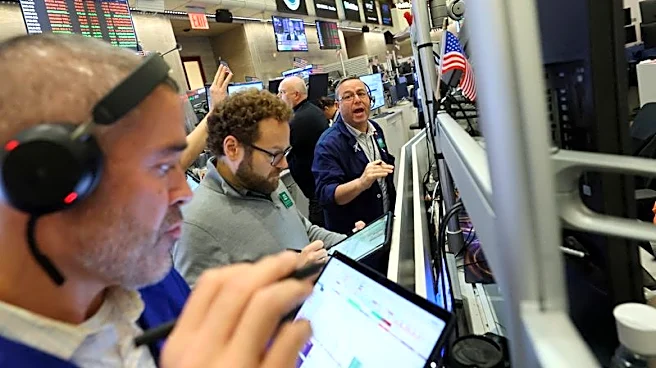
Global equity funds, including those in the U.S., recorded their largest weekly outflow in 14 months during the week ending November 25. Investors withdrew a net $22.73 billion from global equity funds, marking the biggest net sales since September 17,
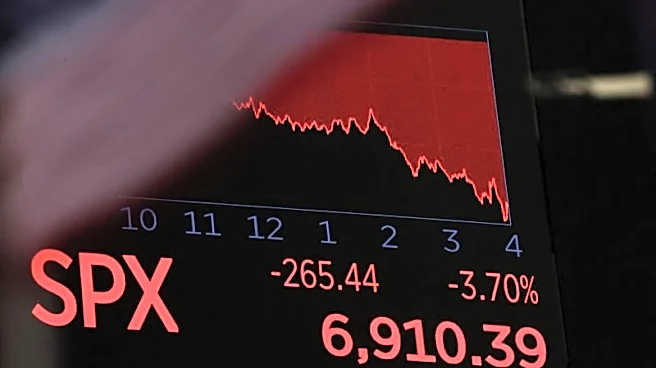
2025, according to LSEG Lipper data. This cautious sentiment was primarily driven by growing concerns over the returns on investments in artificial intelligence (AI) infrastructure and hawkish comments from U.S. Federal Reserve officials, which dampened the appetite for risk assets. U.S. equity funds alone saw net weekly outflows of $30.57 billion, the largest since September 9. The technology sector, along with healthcare and industrial funds, experienced significant pressure, with investors pulling $7.57 billion, $3.04 billion, and $2.56 billion, respectively. The MSCI All Country World Index fell to its lowest level since April 8 last week, though it has since recovered about 3.5%.
Why It's Important?
The substantial outflow from U.S. equity funds signals a significant shift in investor sentiment, reflecting heightened caution regarding the profitability of AI investments and the broader economic outlook. This trend indicates that despite the hype surrounding AI, investors are scrutinizing the tangible returns and sustainability of current valuations. The hawkish stance of U.S. Federal Reserve officials further contributes to this risk aversion, as higher interest rates typically make equity investments less attractive compared to safer assets. The pressure on technology, healthcare, and industrial sectors suggests a broad-based re-evaluation of growth-oriented investments. This could lead to a period of market volatility and a reallocation of capital, potentially impacting the funding landscape for innovative companies and the overall economic growth trajectory in the U.S.
What's Next?
The immediate future will likely see continued investor scrutiny of AI-related investments and a close watch on the U.S. Federal Reserve's monetary policy. If concerns about AI returns persist or if the Federal Reserve maintains a hawkish stance, further outflows from equity funds could occur. This might lead to a more conservative investment environment, with a preference for value stocks or less volatile assets. Companies heavily invested in AI infrastructure may face increased pressure to demonstrate clear pathways to profitability. Conversely, any positive developments in AI returns or a more dovish shift from the Federal Reserve could help stabilize the market and attract investors back to equities. The market will also be looking for signs of economic resilience or weakness to guide future investment decisions.
Beyond the Headlines
The current investor caution surrounding AI investments highlights a critical juncture in the technology cycle. While AI promises transformative potential, the market is now demanding concrete evidence of financial returns to justify the massive capital outlays. This could lead to a more disciplined approach to AI development and deployment, prioritizing applications with clear business cases over speculative ventures. Furthermore, the influence of U.S. Federal Reserve policy on global equity markets underscores the interconnectedness of monetary policy and investor behavior. This period of re-evaluation could ultimately foster a more sustainable and robust AI industry, but it also poses challenges for companies that have relied on speculative growth. The long-term implications include a potential recalibration of tech valuations and a greater emphasis on fundamental financial performance.