





What's Happening?
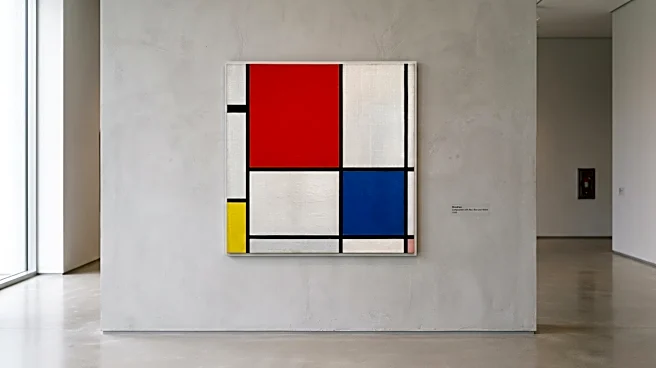
Piet Mondrian's 1930 masterpiece, 'Composition with Red, Blue and Yellow,' is presented as an artistic representation of balance and universal order. The painting features a large red square, smaller blue and yellow patches, white spaces, and black bars,
all meticulously arranged to create a sense of equilibrium. Mondrian believed this arrangement reflected a hidden order underlying all existence. He developed this style, known as Neo-Plasticism, by stripping away representational elements like trees, faces, and horizons, focusing solely on straight lines and flat colors. The 45-centimeter square canvas is housed at the Kunsthaus Zürich. Interestingly, the back of the canvas bears a dedication in French from Mondrian to a friend and colleague, dated January 30, 1930, which speaks of seeking balance 'in art and in life.'
Why It's Important?
Mondrian's 'Composition with Red, Blue and Yellow' holds significant importance in the history of modern art and its influence extends far beyond the canvas. Its principles of geometric abstraction and primary colors have profoundly impacted design, architecture, and visual culture globally, including in the U.S. The painting's exploration of universal balance and order resonates with philosophical and aesthetic discussions about simplicity and harmony. For art enthusiasts and designers in the U.S., it represents a pivotal moment in abstract art, challenging traditional artistic representation and paving the way for new forms of expression. The work's enduring popularity and frequent reproduction in various contexts underscore its lasting cultural impact and its role in shaping modern aesthetics.
What's Next?
The ongoing study and interpretation of Mondrian's work, including 'Composition with Red, Blue and Yellow,' will likely continue to evolve. Art historians and critics will further explore its philosophical underpinnings, its relationship to other modernist movements, and its influence on contemporary art and design. Exhibitions featuring Mondrian's work, both individually and in dialogue with other artists, will continue to draw audiences, fostering new discussions and appreciation. Educational institutions will also continue to use this iconic piece as a cornerstone for teaching abstract art principles. Furthermore, its influence on commercial design and popular culture is expected to persist, as its aesthetic principles remain timeless and adaptable.
Beyond the Headlines
Beyond its visual appeal, Mondrian's 'Composition with Red, Blue and Yellow' delves into profound philosophical questions about the nature of reality and human perception. Mondrian's belief that art could reveal a universal, objective order challenges the notion of art as purely subjective expression. The dedication on the back of the canvas, while personal, reinforces his broader quest for balance in both art and life, suggesting an integration of the personal and the universal. This work also raises ethical considerations about the role of the artist in revealing universal truths versus expressing individual emotion. Culturally, it represents a radical departure from traditional art, pushing boundaries and redefining what constitutes a work of art, thereby influencing subsequent generations of artists to explore abstraction and minimalism.