







What's Happening?
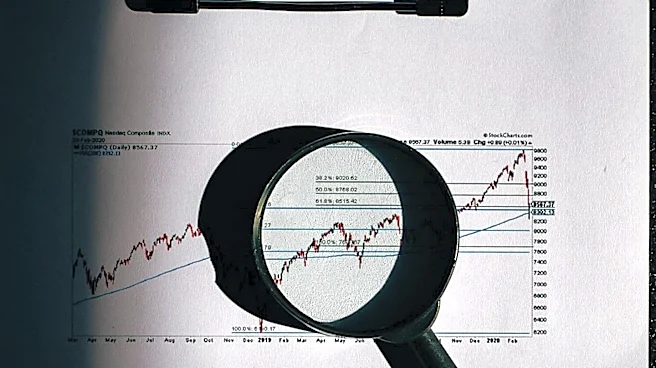
The Nasdaq Composite index experienced a significant decline, falling 2.86% on Friday, extending its October losses. This sell-off is primarily driven by investor concerns regarding the substantial investments in Artificial Intelligence (AI) infrastructure
by major technology companies and whether these expenditures will yield sufficient returns to justify current valuations. Companies like Alphabet, Amazon, and Meta have signaled increased spending on data centers and AI capabilities, leading to questions about capital efficiency, cash flow, and the timeline for monetization. Intel's disappointing outlook, with shares dropping 28.6%, further intensified these concerns, as did Amazon's higher-than-expected negative free cash flow. The market is shifting from a momentum-driven phase to an evidence-driven phase, demanding measurable customer demand, improving margins, and clear timelines for investment recovery.
Why It's Important?
This market correction highlights a critical re-evaluation of the AI investment boom within the U.S. tech sector. Investors are increasingly scrutinizing the financial viability of massive AI infrastructure projects, impacting the valuations of major technology and semiconductor companies. The pressure on companies to demonstrate tangible returns on their AI investments could lead to more disciplined capital allocation and a greater focus on profitability over sheer growth. This shift affects not only the tech giants but also the broader ecosystem of chipmakers, cloud providers, and software companies that supply AI infrastructure. The market's demand for clearer evidence of returns could influence future investment strategies and potentially slow down the pace of AI development if profitability remains elusive.
What's Next?
The immediate future will be shaped by upcoming earnings reports, particularly from Apple and Nvidia in November, which will offer further insights into technology demand, AI spending, and profitability. Investors will be closely watching for evidence that rising infrastructure expenditure is generating meaningful revenue and cash flow. The Nasdaq Composite's ability to hold its 200-day exponential moving average (EMA) will be a critical technical test; a successful defense could stabilize the market, while a decisive break below it could signal a deeper correction. The market is expected to remain volatile, with continued scrutiny on corporate results and their ability to restore confidence in the AI investment cycle.
Beyond the Headlines
The current market sentiment reflects a deeper questioning of the long-term economic model of AI development. While the transformative potential of AI is widely acknowledged, the financial sustainability of its rapid expansion is now under intense scrutiny. This could lead to a more mature phase of AI adoption, where practical applications and demonstrable ROI take precedence over speculative growth. The increased reliance on debt financing for AI buildouts also introduces a layer of financial risk, potentially impacting the stability of the tech sector. This re-evaluation could also spur innovation in cost-effective AI solutions and more efficient infrastructure, as companies seek to balance ambitious AI goals with financial prudence.