






What's Happening?
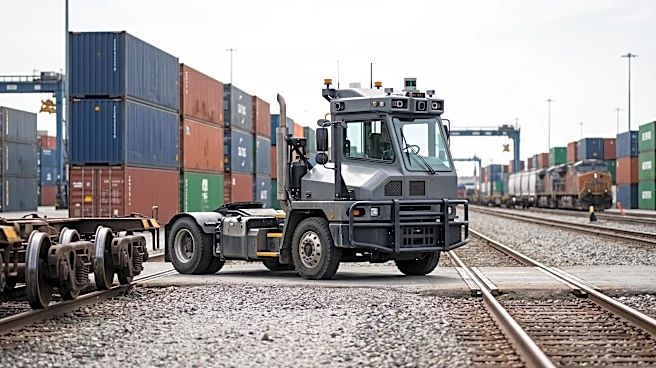
Venti Technologies, a Boston-based company, is set to introduce its driverless container trucks to U.S. intermodal facilities. The company has signed a long-term agreement with an unnamed Class I intermodal railroad to deploy over 130 Venti trucks across
eight sites by 2027, with projections to exceed 600 by the end of the decade. These autonomous trucks are designed to load, move, and unload containers during live yard operations without human operators in the cab or dedicated lanes. A key development for their U.S. deployment involves teaching the trucks to perform complex maneuvers like backing up articulated rigs, a skill not required in their previous operations in Singapore. The U.S. fleet has not yet commenced operations, and the specific railroad and financial terms of the agreement remain undisclosed. Venti Technologies secured $28.8 million in Series A funding in March 2023, led by LG Technology Ventures.
Why It's Important?
The deployment of Venti Technologies' driverless trucks in U.S. intermodal yards signifies a significant advancement in autonomous technology adoption within the logistics sector. This move addresses critical challenges faced by the industry, such as high driver turnover rates, which can reach around 20% monthly in some locations. By automating trackside shuttle operations, these trucks aim to improve efficiency and reduce reliance on human labor for strenuous and often undesirable tasks, particularly in harsh environments like Texas in July. The technology's ability to operate without dedicated lanes and to navigate complex scenarios, including crossing live tracks and backing up 60-foot tractor-trailers with precision, highlights its potential to transform intermodal yard operations. This initiative could lead to a more predictable and less chaotic supply chain, as autonomous vehicles can adhere to precise schedules, enabling a complete redesign of yard layouts and core supply chain processes.
What's Next?
While the U.S. fleet has not yet begun operations, the long-term agreement with a Class I intermodal railroad indicates a phased rollout starting at two of the railroad's busiest U.S. facilities. The initial deployment will likely serve as a critical testing phase to validate the technology's performance and safety in the unique conditions of U.S. rail yards. Success in these initial stages could accelerate the expansion to more than 130 trucks by 2027 and potentially over 600 by the end of the decade. The company's ability to demonstrate reliable and safe operations, particularly in complex maneuvers and interactions with human-driven vehicles and live trains, will be crucial for broader adoption. This development also sets a precedent for other autonomous technology providers looking to target areas beyond middle-mile and long-haul applications in the U.S. logistics landscape.
Beyond the Headlines
The introduction of driverless trucks in U.S. intermodal yards raises deeper implications for the future of labor and infrastructure in the logistics industry. While addressing labor shortages and improving efficiency, the widespread adoption of such technology could lead to shifts in employment for human hostlers and other yard personnel. The ability of these autonomous systems to operate with high precision and predictability could also drive a fundamental rethinking of intermodal yard design, moving towards more controlled and optimized layouts. This technological shift could enhance safety by reducing human error in hazardous environments and potentially lead to a more resilient supply chain less susceptible to labor disruptions. Furthermore, the integration of AI-powered vehicles that can 'see' and react to trains and other dynamic elements on their own represents a significant leap in autonomous decision-making capabilities within complex industrial settings.