

What's Happening?
United States Steel Corporation selected Osceola, Arkansas, for its newest steel mill after considering 48 states. Daniel Brown, U.S. Steel’s executive vice president of advanced technology steelmaking and CEO of Big River Steel, stated that reliable
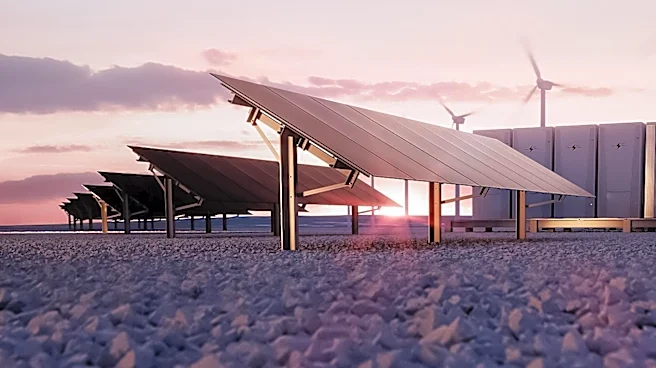
and affordable electricity was a primary factor in this decision. The same region in Mississippi County is now home to Cypress Creek's Steel River Energy Center, which utilizes solar and battery storage. The steel piles for this energy center are fabricated by PACO Steel & Engineering in nearby Blytheville, using coils from Big River Steel, ensuring the steel remains within the county. Kevin Smith, CEO of Cypress Creek, noted that solar and storage technologies have become cost-competitive and no longer rely solely on incentives, making them attractive to utilities and corporate buyers based on economic viability.
Why It's Important?
This decision by U.S. Steel signifies a critical shift in American manufacturing, demonstrating that renewable energy solutions like solar and battery storage are now economically viable and competitive for large-scale industrial operations. The availability of affordable and reliable electricity, increasingly sourced from renewables, is becoming a key determinant for industrial site selection. This trend supports the growth of American manufacturing by providing a cost-effective energy foundation, which is essential for global competitiveness. The localized supply chain, where steel for the energy center is sourced and fabricated within the same county, also highlights a move towards more resilient and integrated domestic production ecosystems. This investment is expected to stimulate local economies, as evidenced by new businesses and increased residential movement in Osceola.
What's Next?
The success of the Steel River Energy Center and U.S. Steel's new mill in Osceola could serve as a model for future industrial development across the United States. As solar and storage technologies continue to advance and become more widespread, more manufacturing companies may prioritize locations with access to such energy solutions. This could lead to increased investment in renewable energy infrastructure in various states, further driving down energy costs for industries. The economic impact on Osceola, with new restaurants and residents, suggests a positive feedback loop where industrial growth fueled by sustainable energy leads to broader community development. This trend is likely to accelerate as companies seek both economic efficiency and environmental sustainability.
Beyond the Headlines
The choice of Osceola, Arkansas, by U.S. Steel, driven by the availability of affordable solar and storage, underscores a profound transformation in the energy landscape and its intersection with industrial policy. This development challenges the traditional perception that heavy industries are inherently tied to fossil fuels. It highlights the growing role of renewable energy in fostering American industrial competitiveness, not just as an environmental imperative but as an economic advantage. The replicable and modular design of solar and storage systems allows for their deployment across diverse geographies, potentially decentralizing industrial growth and bringing economic benefits to a wider range of communities. This also signals a long-term shift in how U.S. manufacturing will power its operations, moving towards a more sustainable and resilient energy future.