







What's Happening?
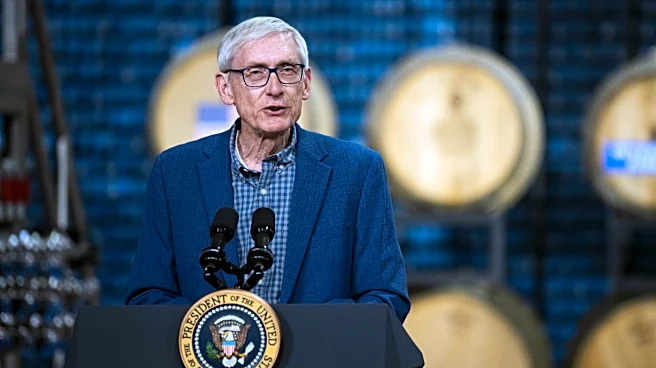
Wisconsin Governor Tony Evers, alongside the Wisconsin Economic Development Corporation (WEDC), has announced up to $15 million in tax incentives for Realta Fusion. This funding will support the company's $800 million project to establish its corporate
headquarters and a research and development facility, named 'The Realta Forge,' at the former Oscar Mayer plant site in Madison. The project is expected to create over 500 high-paying jobs. This initiative aligns with Governor Evers' broader commitment to achieving 100 percent carbon-free electricity consumption in Wisconsin by 2050. The WEDC Board of Directors approved performance-based Enterprise Zone (EZ) tax credits, with the final amount contingent on capital investment and job creation. Realta Fusion plans to break ground on its facility, where it will build a prototype magnetic mirror fusion machine called Hammir, before the end of the year. This announcement follows previous legislative actions by Governor Evers, including exempting fusion energy project capital expenditures from state sales and use taxes and creating a Nuclear Power Summit Board.
Why It's Important?
This investment signifies Wisconsin's strategic commitment to becoming a national hub for fusion energy commercialization, with significant implications for the U.S. clean energy sector and economic development. By attracting Realta Fusion, Wisconsin is positioning itself at the forefront of advanced energy technology, potentially fostering a new industry cluster that could drive innovation, create high-skilled jobs, and attract further investment. For the U.S., the successful development of commercial fusion energy could offer a virtually limitless, carbon-free power source, addressing critical energy security and climate change challenges. This move could also inspire other states to invest in similar high-tech energy ventures, accelerating the national transition to a clean energy economy. The creation of over 500 jobs in Madison represents a substantial economic boost for the region, diversifying its industrial base and leveraging its academic strengths, particularly the University of Wisconsin-Madison's long-standing leadership in fusion research. This public-private partnership demonstrates a model for how states can proactively support emerging technologies to achieve both economic and environmental goals.
What's Next?
Realta Fusion is expected to break ground on 'The Realta Forge' research and development facility in Madison before the end of the year, commencing the construction of its prototype magnetic mirror fusion machine, Hammir. The company's receipt of the full $15 million in tax credits will depend on its capital investment and job creation metrics. Concurrently, Wisconsin's Public Service Commission (PSC) and the University of Wisconsin-Madison Department of Nuclear Engineering and Engineering Physics are conducting a nuclear power siting study, mandated by 2025 Wisconsin Act 12, which is due by early 2027. This study will evaluate potential nuclear energy development opportunities, including fusion, across the state. The Nuclear Power Summit Board, established by 2025 Wisconsin Act 11, will also work to advance nuclear and fusion technology and development, culminating in a nuclear power summit in Madison. These ongoing efforts aim to solidify Wisconsin's leadership in the nuclear industry and further its goal of 100% carbon-free electricity by 2050.
Beyond the Headlines
Wisconsin's aggressive pursuit of fusion energy development, exemplified by the Realta Fusion investment, signals a broader shift in how states are approaching long-term energy solutions and economic growth. This initiative moves beyond traditional renewable energy sources to embrace cutting-edge, high-risk, high-reward technologies. The ethical implications revolve around the responsible development of advanced nuclear technologies, ensuring safety, waste management, and equitable access to the benefits of fusion power. Legally, the state's proactive measures, such as tax exemptions for fusion projects, set a precedent for regulatory frameworks that can accelerate technological innovation. Culturally, this positions Wisconsin as a forward-thinking state willing to invest in the scientific frontier, potentially attracting a new generation of scientists, engineers, and entrepreneurs. The long-term impact could be a redefinition of energy infrastructure, moving towards a decentralized, carbon-free grid, and establishing new global standards for energy production and consumption, with Wisconsin playing a pivotal role in this transformation.