






What's Happening?
GE Appliances, a company owned by the Chinese conglomerate Haier, is extensively integrating Artificial Intelligence (AI) into its manufacturing operations at its Roper Corp. plant in rural northwest Georgia. This initiative aims to minimize errors, reduce
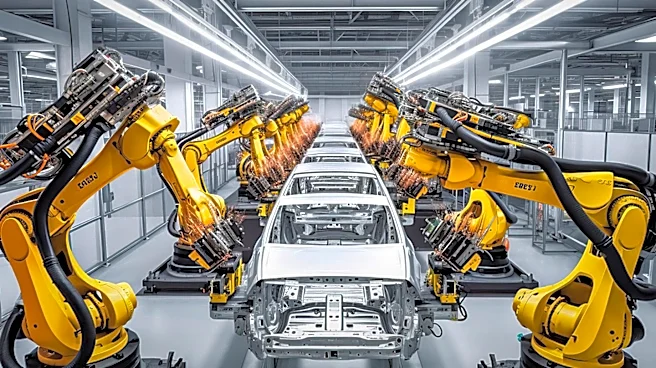
equipment downtime, and ensure product quality to compete effectively with overseas imports. The plant utilizes autonomous vehicles for parts delivery, robots for assembly, and AI-powered cameras and sensors to detect anomalies, such as an incorrect gasket on an oven. If an error is detected, the system automatically shuts down that section of the assembly line and alerts staff. According to Tony Gabbert, the plant's director of manufacturing operations, these AI-powered quality control systems are crucial for early error detection and rapid resolution. Bill Good, GE Appliances' vice president of manufacturing, estimates that every percentage point of improvement achieved through AI saves the company between $1.5 million and $2 million annually. The company has been collecting data through cameras and sensors for over a decade, generating millions of lines of data daily, which its 'Brilliant Factory' data platform uses to provide real-time insights into plant operations.
Why It's Important?
The adoption of AI by GE Appliances signifies a critical shift in the U.S. manufacturing sector's strategy to maintain competitiveness against international rivals, particularly those with lower labor costs. By leveraging AI for predictive maintenance, quality control, and operational optimization, American factories can achieve higher levels of efficiency and product perfection. This technological advancement helps neutralize the cost advantages of overseas manufacturing, potentially safeguarding and even creating jobs within the U.S., as evidenced by GE Appliances adding 600 jobs in Georgia following a $180 million expansion. The ability of AI to analyze vast datasets and provide actionable insights allows plant managers to proactively address issues, preventing costly breakdowns that can halt production lines and incur significant financial losses. This focus on speed and precision in problem-solving is becoming the 'name of the game' in modern manufacturing, ensuring that U.S.-made products meet stringent quality standards and remain competitive in the global market.
What's Next?
GE Appliances plans to continue expanding its use of AI beyond quality control and predictive maintenance. The company is already utilizing AI to optimize staffing by reassigning workers to different tasks based on real-time needs and to forecast market demand, enabling last-minute production adjustments. This strategic integration of AI is expected to further enhance the company's agility and responsiveness to market fluctuations. The success of GE Appliances in leveraging AI could serve as a model for other U.S. manufacturers facing similar competitive pressures, potentially leading to broader adoption of advanced AI technologies across the American industrial landscape. The ongoing development and implementation of AI in manufacturing will likely drive further innovation in operational efficiency, supply chain management, and workforce optimization, contributing to the long-term viability and growth of domestic production.
Beyond the Headlines
The extensive deployment of AI in manufacturing, as demonstrated by GE Appliances, raises deeper implications regarding the future of work and the human-machine interface in industrial settings. While Bill Good, vice president of manufacturing, believes AI will not replace large populations of humans in the foreseeable future, its capacity to 'outthink' even seasoned veterans like him highlights a fundamental shift in the nature of expertise and decision-making on the factory floor. The reliance on AI for critical troubleshooting and optimization tasks could lead to a redefinition of roles, emphasizing human oversight, system management, and strategic planning rather than manual intervention. This evolution also underscores the ethical considerations of AI in the workplace, including data privacy, algorithmic bias, and the need for continuous training and upskilling of the workforce to adapt to these new technological paradigms. Ultimately, the integration of AI is not just about efficiency gains but about fundamentally transforming the operational philosophy and competitive dynamics of U.S. manufacturing.