






What's Happening?
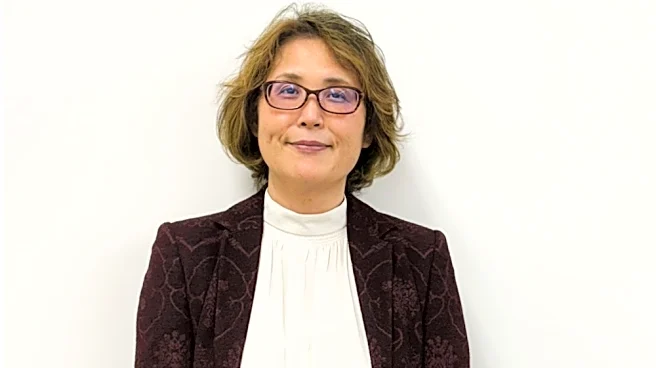
German director Angela Schanelec, known for her 'elliptical' filmmaking style, recently discussed her work and the challenges of marketing her films during an interview at the 39th Tokyo International Film Festival. Her latest film, 'My Wife Cries,' which
premiered at the Berlin International Film Festival and opened in Germany in June, has secured distribution only in the U.S. and South Korea outside of Germany. Schanelec's films often focus on the everyday lives of characters and the consequences of unseen dramatic incidents, rather than conventional plot points. She describes her approach as more honest, controlling the filmmaking process meticulously with static scenes and no improvisation. This method, she admits, makes her films difficult to sell and limits her audience, as evidenced by the approximately 6,000 tickets sold for 'My Wife Cries' in Germany.
Why It's Important?
Schanelec's insights highlight the broader challenges faced by independent and art-house filmmakers in the U.S. and global film markets. Her struggle to secure wider distribution for a critically acclaimed film, despite its premiere at a major festival like Berlin, underscores the commercial pressures that often prioritize mainstream appeal over unique artistic vision. For U.S. audiences, the limited distribution means fewer opportunities to engage with diverse international cinema that challenges conventional storytelling. This situation also impacts the financial viability of such filmmakers, making it difficult for them to continue their work. The U.S. market, while large, can be particularly challenging for films that do not fit established commercial molds, affecting cultural diversity in cinematic offerings and potentially limiting the exposure of American viewers to different narrative forms.
What's Next?
Following her participation at the 39th Tokyo International Film Festival, Angela Schanelec is scheduled to appear at another retrospective in Tokyo and several universities. This continued engagement suggests an effort to cultivate an audience through non-traditional channels, such as film festivals and academic settings, which often serve as crucial platforms for independent cinema. The limited U.S. distribution of 'My Wife Cries' indicates that future releases of her films in the U.S. may continue to rely on specialized distributors, film festivals, and streaming platforms that cater to niche audiences. The ongoing challenge for Schanelec and similar filmmakers will be to find sustainable models for funding and distribution that allow them to reach a broader international audience while maintaining their artistic integrity.
Beyond the Headlines
The discussion around Angela Schanelec's filmmaking methodology and market struggles points to a deeper tension within the film industry between artistic expression and commercial viability. Her rejection of conventional narrative structures and her meticulous, non-improvisational approach challenge audience expectations and industry norms. This raises questions about the role of film as both an art form and a commercial product, and how these two aspects can coexist. The difficulty in selling her films, despite critical acclaim, highlights a potential disconnect between critical reception and audience engagement, particularly in markets like the U.S. It also underscores the importance of film festivals in providing exposure for works that might otherwise be overlooked by mainstream distribution channels, fostering a more diverse cinematic landscape.