






What's Happening?
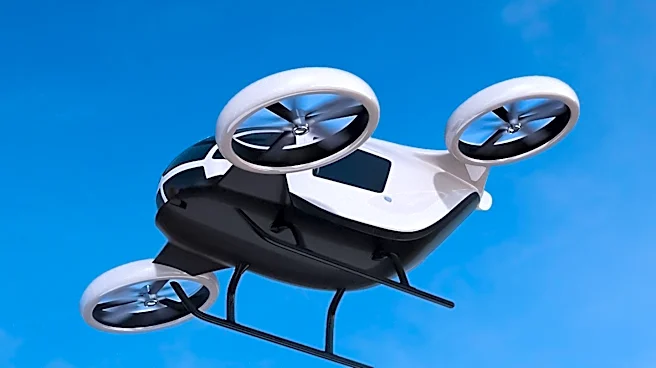
Horizon Aircraft is developing the Cavorite X7, a hybrid-electric vertical take-off and landing (VTOL) aircraft designed to operate primarily as a conventional fixed-wing aircraft. This architectural choice aims to mitigate certification risks associated
with multiple exposed rotors and to achieve Instrument Flight Rules (IFR) and known-icing capabilities. According to Brandon Robinson, co-founder and chief executive of Horizon Aircraft, the X7 will fly in a traditional configuration for 98 percent of its mission, making it unique in the Advanced Air Mobility (AAM) world. The hybrid-electric propulsion system, utilizing a turbine engine driving a generator, allows for the integration of established anti-icing systems, further addressing critical operational challenges.
Why It's Important?
Horizon Aircraft's approach with the Cavorite X7 is significant for the U.S. advanced air mobility sector because it directly addresses some of the most formidable challenges to commercial viability: certification and all-weather operation. By designing the X7 to function predominantly as a fixed-wing aircraft, Horizon aims to leverage existing aviation standards and reduce the regulatory hurdles typically faced by novel VTOL designs. This strategy could accelerate the deployment of advanced air mobility solutions for critical missions such as medevac, search-and-rescue, and regional logistics, where reliability in adverse weather conditions is paramount. The potential for lower operating costs and increased range compared to traditional helicopters or short-range eVTOLs could make the Cavorite X7 a disruptive force, offering more accessible and efficient services and potentially expanding the market for advanced air mobility in the U.S.
What's Next?
Horizon Aircraft will continue its development and testing phases for the Cavorite X7, focusing on demonstrating its fixed-wing flight capabilities and the effectiveness of its hybrid-electric propulsion and anti-icing systems. The company's immediate next steps will involve rigorous flight testing to validate its performance claims and gather data for regulatory submissions. A key focus will be on securing IFR and known-icing certification, which is crucial for its target utility missions. Horizon Aircraft is also relying on public support, such as the INSAT program, to de-risk development, particularly for key icing protective systems. As development progresses, the company will aim to scale its engineering team and move from prototypes to full-scale testing, leveraging Canada's aerospace ecosystem for supply chains and certification experience.
Beyond the Headlines
The Cavorite X7's design philosophy, prioritizing conventional fixed-wing operation and hybrid-electric power, highlights a deeper industry trend towards pragmatic innovation in advanced air mobility. Rather than solely pursuing radical new designs, some companies are focusing on integrating proven technologies to overcome regulatory and operational barriers. This approach could lead to a more rapid and widespread adoption of VTOL aircraft, as it reduces the perceived risk for regulators and operators. The emphasis on all-weather capability and cost-effectiveness also suggests a shift towards utility-focused applications, potentially opening up new markets beyond urban air taxis. This could have long-term implications for regional transportation, emergency services, and logistics, making advanced air mobility a more integral part of the national infrastructure and potentially influencing future aviation policy and investment strategies.