




What's Happening?
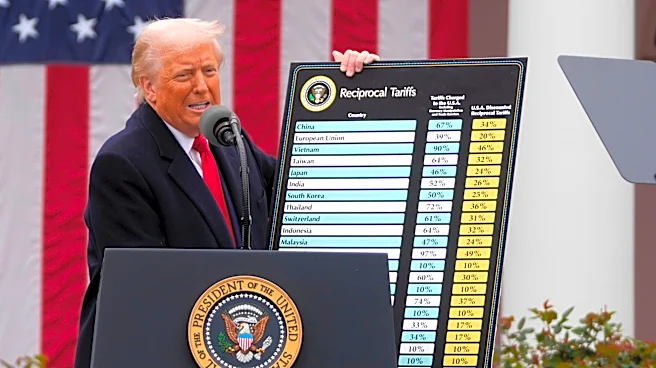
The Peterson Institute for International Economics (PIIE) has released findings indicating that U.S. tariffs on China, initiated during President Trump's administration, have not significantly reduced American reliance on Chinese suppliers. Despite a decrease
in the volume of direct Chinese imports, the share of Chinese value-added content in U.S. imports remains substantial. The report highlights that while the share of Chinese imports dropped from 18% in 2018 to about 11% in 2024, the value-added share of Chinese content in U.S. imports only decreased slightly from 17.7% to 15.4%. This suggests that Chinese goods are increasingly entering the U.S. market through third countries, circumventing direct trade routes affected by tariffs.
Why It's Important?
The findings underscore the complexity of global supply chains and the challenges in decoupling from Chinese economic influence. The persistence of Chinese value-added content in U.S. imports despite tariffs suggests that the intended economic pressure on China has not fully materialized. This has implications for U.S. trade policy and economic strategy, as it highlights the limitations of tariffs as a tool for reducing dependency on foreign suppliers. The continued reliance on Chinese goods, albeit indirectly, may affect U.S. manufacturing and consumer markets, potentially influencing future trade negotiations and economic policies.
What's Next?
The report suggests that U.S. policymakers may need to explore alternative strategies beyond tariffs to effectively reduce dependency on Chinese suppliers. This could involve strengthening domestic manufacturing capabilities or diversifying supply sources. The ongoing economic relationship between the U.S. and China will likely remain a focal point in trade discussions, with potential adjustments in policy to address the challenges highlighted by the PIIE findings.