





What's Happening?
Genesis AI, a robotics firm operating in Paris and California, has successfully secured $500 million in Series A funding, pushing its post-money valuation to $3.5 billion. This substantial capital injection was co-led by Premji Invest, Khosla Ventures,
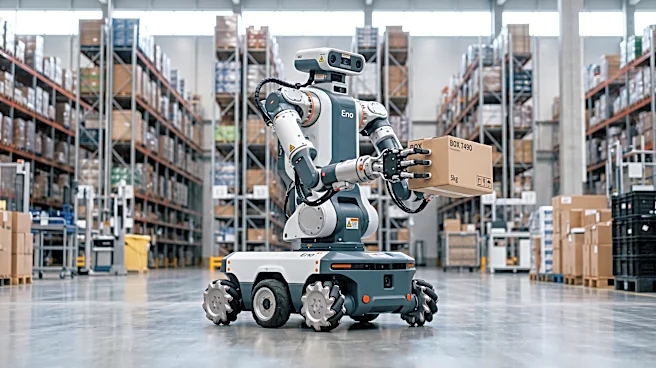
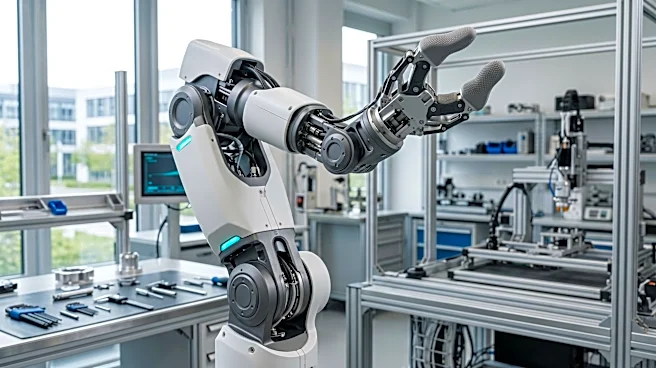
and Eclipse, with additional significant contributions from T. Rowe Price, Nvidia, and notable individual investors including former Google CEO Eric Schmidt and Zoom CEO Eric Yuan. The primary objective for this funding is to scale the production of Genesis AI's flagship robot, Eno, which is engineered for diverse applications across manufacturing, logistics, and laboratories. The company also plans to expand its reach into the hospitality and healthcare sectors. Zhou Xian, co-founder and CEO of Genesis AI, emphasized the company's commitment to developing a reliable general-purpose robot capable of executing complex tasks consistently in real-world environments. Genesis AI integrates hardware, AI models, simulation technology, and training systems in-house, utilizing proprietary technologies like GENE, an AI foundation model for robotic manipulation, and Genesis World, a simulation platform for training and evaluating robotic capabilities.
Why It's Important?
This significant funding round for Genesis AI underscores a robust investor confidence in the burgeoning market for general-purpose robotics, signaling a potential shift in automation across various U.S. industries. The development of versatile robots like Eno, designed for manufacturing, logistics, hospitality, and healthcare, could redefine operational efficiencies and productivity. For U.S. businesses, this could mean enhanced automation capabilities, reduced operational costs, and improved task execution in complex environments. Industries facing labor shortages or seeking to optimize processes stand to gain significantly from advanced robotic solutions. The integrated approach by Genesis AI, combining hardware with sophisticated AI and simulation, aims to create more reliable and adaptable robots, potentially setting a new standard in the competitive robotics landscape. This investment also highlights the increasing strategic importance of AI and machine learning in driving the next wave of automation, impacting job markets and economic structures as companies adopt these technologies to maintain competitiveness.
What's Next?
Genesis AI plans to allocate the newly acquired $500 million primarily towards scaling the production of its Eno robot. This expansion will enable the company to meet the increasing demand for automation across various sectors, including manufacturing, logistics, hospitality, and healthcare. The firm will continue to develop and refine its proprietary technologies, GENE and Genesis World, to enhance the performance and reliability of its robots. As Genesis AI ramps up its production capabilities and expands its workforce, it is poised to capitalize on the growing global robotics market, which is projected for significant growth due to advancements in AI and machine learning. The company's success will hinge on its ability to navigate the challenges of scaling production while maintaining quality and performance, as well as its capacity to continually innovate and adapt to the fast-changing technological landscape in robotics.
Beyond the Headlines
The substantial investment in Genesis AI and its focus on general-purpose robots could trigger deeper implications for the U.S. workforce and economy. The widespread adoption of highly adaptable robots capable of complex tasks may lead to significant shifts in labor demands, potentially displacing human workers in routine or physically demanding roles across multiple industries. This raises ethical considerations regarding job displacement and the need for workforce retraining initiatives to prepare for an increasingly automated future. Furthermore, the integration of advanced AI in robotics, as seen with Genesis AI's GENE foundation model, could lead to new legal and regulatory challenges concerning autonomous decision-making and accountability in robotic operations. The long-term societal impact could include a redefinition of human-robot collaboration, potentially fostering new industries and job categories centered around robot maintenance, programming, and oversight, while also necessitating public policy discussions on the equitable distribution of automation's benefits.