





What's Happening?
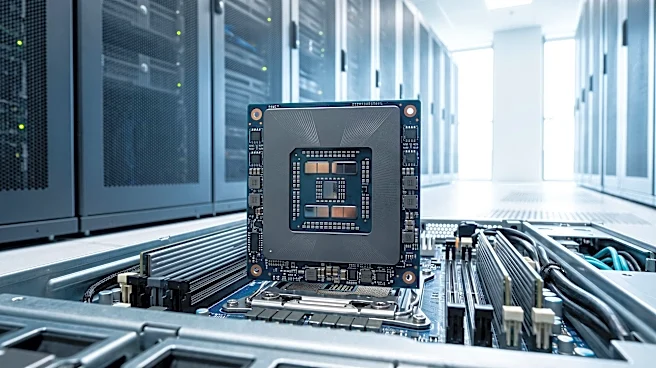
Advanced Micro Devices (AMD) and Micron Technology (MU) represent distinct opportunities within the AI semiconductor market, despite both benefiting from AI demand. AMD, operating on a fabless design model, focuses on compute silicon like EPYC server
CPUs and Instinct GPUs for data centers. Its latest quarterly results showed a 45% year-over-year revenue increase, with the data center segment nearly doubling, and management projects data center GPU revenue could surpass server CPU revenue, with overall growth potentially exceeding 80% in the coming year. However, AMD's stock has experienced notable volatility due to broader questions about AI infrastructure valuations and a softer PC market. Micron, a capital-intensive manufacturer, produces memory and storage components, including HBM for AI accelerators. It has seen record revenue and margin expansion due to tight supply and robust AI-driven demand, with HBM capacity effectively sold out for the coming year.
Why It's Important?
The contrasting business models of AMD and Micron highlight different risk profiles and investment opportunities within the U.S. semiconductor industry's AI boom. AMD's premium valuation and reliance on sustained rapid growth make its stock more sensitive to market sentiment and competitive pressures from larger players. Micron, benefiting from a supply-constrained memory market, enjoys strong pricing power and multi-quarter visibility, leading to steadier upward momentum. This distinction is crucial for investors seeking to understand how different segments of the AI value chain are performing. The intense demand for AI components is driving significant revenue growth for both companies, but their unique positions in the supply chain dictate their financial stability and growth trajectories, impacting the broader technology market and its stakeholders.
What's Next?
AMD's future performance hinges on the successful execution of its Helios rack-scale systems and next-generation accelerators, especially amidst strong competition. The market will closely watch whether its rapid growth can sustain its premium valuation. Micron's outlook is tied to continued HBM capacity growth and ongoing memory shortages across data center, PC, and mobile markets. While memory pricing is cyclical, the current constrained environment is expected to support its consistent upward path. Tickeron's AI currently favors Micron over AMD due to its steadier near-term earnings path, driven by sold-out HBM capacity and strong guidance. However, this assessment is probabilistic and subject to changing market conditions and competitive dynamics.
Beyond the Headlines
The divergent paths of AMD and Micron illustrate the complex and interconnected nature of the AI supply chain. AMD's focus on high-margin design and compute power, versus Micron's capital-intensive manufacturing of essential memory components, reveals how different strategies can thrive in the same burgeoning market. This dynamic also underscores the critical role of memory in AI acceleration; without high-bandwidth memory (HBM), the performance of advanced GPUs would be severely limited. The current supply-demand imbalance in memory, particularly HBM, highlights a potential bottleneck for the broader AI industry, which could impact the pace of AI development and deployment across various sectors of the U.S. economy. Understanding these interdependencies is key to grasping the full implications of the AI revolution.