






What's Happening?
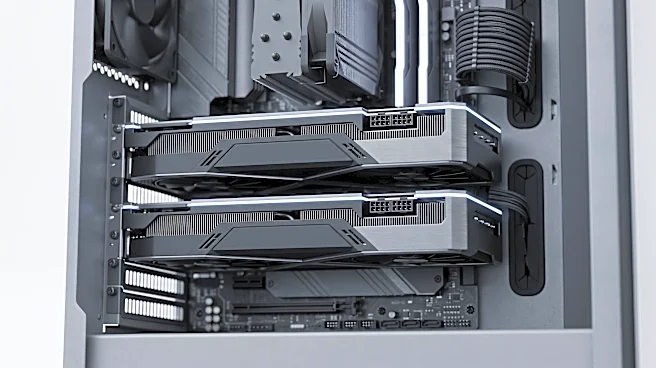
A developer has demonstrated a significant performance enhancement for NVIDIA's DLSS 5 Neural Rendering technology by utilizing a second GPU to offload neural post-processing. This mod, which uses a ReShade add-on called MGPU Bridge, allows the game to render
on one GPU while the neural rendering tasks are handled by a separate graphics card. This setup has shown to boost neural-rendered frames per second (FPS) by up to 127% in certain scenarios, such as in Cyberpunk 2077 and a cinematic video from The Blood of Dawnwalker. The developer, Marcelo Guibout, clarified that these are technical showcases rather than official benchmarks. The method also leads to temperature reductions on the primary rendering card, running up to 21 degrees cooler without the neural load. This approach is reminiscent of older dedicated PhysX GPUs, where specific tasks were delegated to a secondary card.
Why It's Important?
This development is important for the U.S. gaming and technology industries as it showcases a novel way to maximize the performance of advanced rendering technologies like NVIDIA's DLSS 5. By demonstrating that neural rendering can be effectively offloaded to a second GPU, it opens up possibilities for gamers with multi-GPU setups to achieve significantly higher frame rates and potentially cooler operating temperatures for their primary graphics cards. While not an official NVIDIA solution, this mod highlights the potential for future hardware and software optimizations in neural rendering. It could influence how game developers and hardware manufacturers approach the integration of AI-powered graphics features, potentially leading to more efficient and powerful gaming experiences. This innovation could also spur further research and development into distributed processing for graphics, benefiting high-performance computing and AI applications beyond gaming.
What's Next?
The developer has made the project available on GitHub, allowing other users to experiment with the dual-GPU DLSS 5 setup. However, it requires a second display and introduces increased display latency, which may limit its widespread adoption for competitive gaming. While NVIDIA has not officially endorsed this method, the success of this mod could prompt the company or other developers to explore similar multi-GPU solutions for neural rendering in the future. This could lead to official software updates or new hardware designs that natively support distributed processing for AI-driven graphics. The gaming community will likely continue to experiment with and refine such modifications, potentially leading to more user-friendly implementations or further performance gains. The long-term impact could be a shift in how high-end gaming systems are configured, with a greater emphasis on specialized co-processing units for AI tasks.
Beyond the Headlines
This technical achievement underscores a broader trend in computing: the increasing specialization and distribution of processing tasks, particularly with the rise of artificial intelligence. Just as dedicated PhysX cards once handled physics calculations, this mod suggests a future where AI-driven graphics features like neural rendering might benefit from dedicated hardware or multi-GPU configurations. This could lead to a more modular and scalable approach to graphics processing, where different components are optimized for specific computational loads. The ethical implication lies in accessibility; while powerful for those with multiple GPUs, it could widen the performance gap for users with single-card setups. Culturally, it reflects the ongoing innovation within the PC modding community, pushing the boundaries of what's possible with existing hardware and inspiring official development efforts.