

What's Happening?
Rogers Hornsby, a legendary baseball player known for his exceptional hitting, is being recognized for his complex career, particularly his time with the Chicago Cubs. Hornsby played 12 outstanding years for the Cardinals from 1915-1926, winning the NL
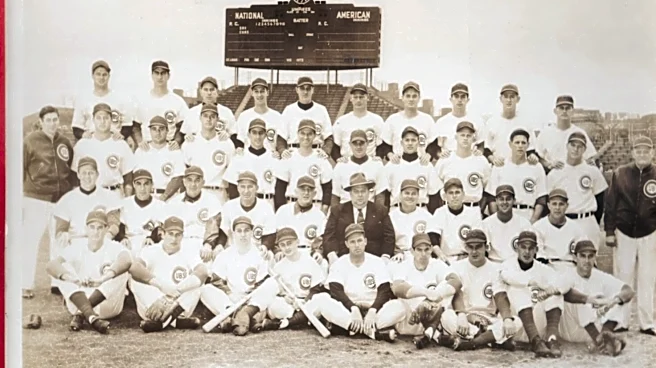
MVP in 1925 and achieving one of the greatest MLB seasons ever in 1924 with a .424 batting average. He also managed the Cardinals in 1925 and 1926. After a contract dispute, he was traded to the Giants, then the Braves, and eventually to the Cubs in 1929 for a substantial sum. His 1929 season with the Cubs was remarkable, batting .380 with 39 home runs. However, his tenure with the Cubs turned sour due to a broken ankle in 1930 and his difficult personality as a player-manager. Cubs owner William Wrigley made him player-manager for 1931, a decision that led to significant internal strife and his eventual firing in 1932. Hornsby was known for being blunt and opinionated, which often put him at odds with teammates and management.
Why It's Important?
Rogers Hornsby's career with the Chicago Cubs, though marked by individual brilliance, underscores the critical role of team dynamics and managerial relationships in professional sports. His exceptional on-field performance in 1929, following a significant trade, demonstrates the immediate impact a star player can have. However, his subsequent struggles as a player-manager highlight how personality clashes and leadership styles can undermine even the most talented individuals, affecting team cohesion and performance. The decision by Cubs owner William Wrigley to appoint Hornsby as player-manager, despite internal dissent, illustrates the high-stakes nature of managerial appointments in baseball and the potential for such decisions to alter a franchise's trajectory. Hornsby's story serves as a historical example of how a player's off-field conduct and interpersonal skills can be as crucial as their athletic prowess in shaping their legacy and a team's success.
What's Next?
While Rogers Hornsby's playing and managing career concluded decades ago, his legacy continues to be analyzed within the context of baseball history. His inclusion in 'The Top 100 Cubs of all time' series indicates ongoing efforts to evaluate and rank historical figures in sports, prompting discussions among fans and historians about his impact. Future analyses of baseball's greatest players and managers will likely continue to reference Hornsby's unique blend of unparalleled skill and controversial personality. His story may also serve as a case study for sports management programs or discussions on leadership in professional athletics, examining the challenges of managing strong personalities and the balance between individual talent and team harmony. The recognition of his ability to spot talent, as evidenced by his early assessment of Ron Santo and Billy Williams, suggests that his 'hitters' eye' remains a notable aspect of his baseball acumen.
Beyond the Headlines
Rogers Hornsby's career extends beyond mere statistics, offering insights into the cultural and social aspects of early 20th-century baseball. His reputation as a difficult personality, coupled with his admitted bigotry and anti-Semitic views, reflects broader societal attitudes of the era, even as he maintained friendships across different backgrounds. His gambling on horses, which reportedly put him at odds with Commissioner Landis, touches upon the ethical challenges and integrity issues that have historically plagued professional sports. Hornsby's blunt and outspoken nature, while contributing to his professional turmoil, also paints a picture of a fiercely independent individual. His famous quote about waiting for spring during the winter encapsulates the deep passion and singular focus many baseball players held for the game, providing a timeless sentiment that resonates with fans and players alike. His story is a microcosm of the complexities inherent in human achievement, where extraordinary talent can coexist with significant personal flaws.