


What's Happening?
Former Pittsburgh Steelers offensive coordinator Bruce Arians has revealed that his departure from the team, which occurred when his contract was not renewed by then-head coach Mike Tomlin, was ultimately a positive turning point in his career. For years,
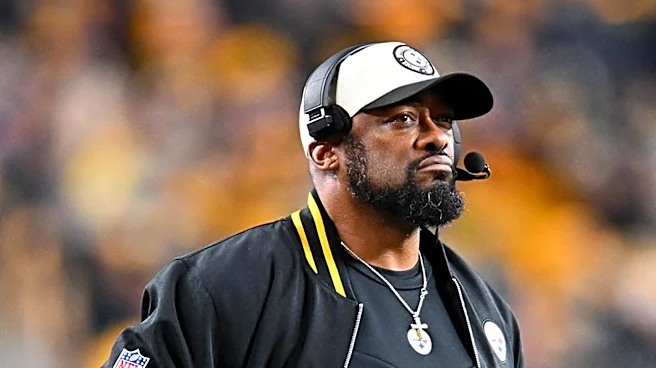
the Steelers maintained that Arians had retired, but he clarified on the 'Not Just Football with Cam Heyward' podcast that he was effectively 'refired.' Arians recounted that Tomlin had initially expressed satisfaction with his performance and even suggested an extension. However, after a brief offseason trip, Tomlin informed him that his contract would not be renewed. This decision, which Arians initially found hurtful and a betrayal, stemmed from concerns within the front office and Tomlin about Arians' offensive style, particularly the perceived lack of running plays, and his close relationship with quarterback Ben Roethlisberger.
Why It's Important?
Arians' reflection on his departure from the Steelers highlights the often-unseen dynamics and political considerations within professional sports organizations. His experience underscores how coaching changes, even those perceived as negative at the time, can inadvertently open doors to greater opportunities and career advancement. For the Steelers, the decision to let Arians go, despite his contributions to multiple Super Bowl appearances, reveals a strategic shift in offensive philosophy and concerns about team control. This event also illustrates the complex relationship between head coaches, coordinators, and star players, where personal connections and strategic disagreements can influence significant personnel decisions. Arians' subsequent success as a head coach, including winning a Super Bowl with the Tampa Bay Buccaneers, validates his perspective that the 'firing' was a catalyst for his career, demonstrating that perceived setbacks can lead to unforeseen triumphs in the highly competitive world of professional sports.
What's Next?
While Arians' departure from the Steelers is a past event, his recent comments continue to shape the narrative around Mike Tomlin's coaching legacy and the Steelers' organizational decisions during that period. For Arians, his career trajectory after leaving Pittsburgh saw him become an interim head coach for the Indianapolis Colts, where he won AP NFL Coach of the Year, and then a successful head coach for the Arizona Cardinals and the Tampa Bay Buccaneers, leading the latter to a Super Bowl LV victory. He has since transitioned into an upper-management role as a senior football consultant for the Buccaneers. His story serves as an ongoing example of resilience and adaptation in the face of professional adversity, offering a long-term perspective on career development in the NFL. The Steelers, under Mike Tomlin's continued leadership until 2025, maintained a consistent record, but the cultural impact of such personnel decisions often resonates for years within the franchise.
Beyond the Headlines
Bruce Arians' candid account offers a deeper insight into the human element of professional sports, where personal ambition, organizational politics, and strategic vision intersect. His initial feelings of hurt and betrayal, followed by a retrospective understanding of his 'firing' as a blessing, illustrate a common psychological journey in high-stakes careers. This narrative transcends the specifics of football, touching upon themes of professional growth, the redefinition of success, and the often-unpredictable nature of career paths. It also subtly critiques the public relations aspect of sports organizations, where the official narrative (Arians 'retired') often differs from the internal realities. Arians' success post-Steelers also raises questions about the long-term wisdom of certain personnel decisions made by teams, suggesting that sometimes, letting go of talent can inadvertently empower it elsewhere, leading to a more competitive landscape across the league.