







What's Happening?
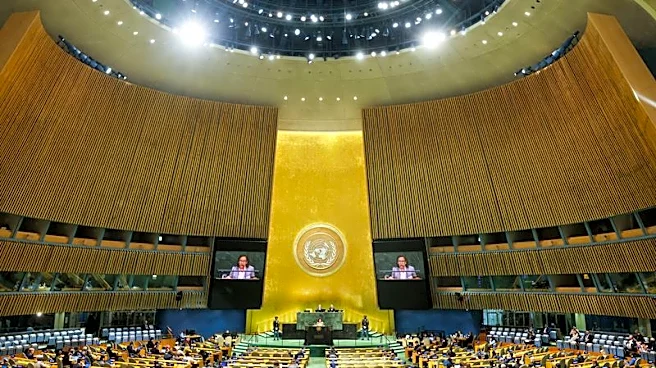
The 1958 film 'War of the Satellites,' directed by Roger Corman, is being reviewed as a Cold War-era sci-fi classic. The movie opens with the United Nations' space program facing a 'space barrier' that destroys ten manned spaceships. An unseen alien group
then sends a missile to Earth with a message: humanity is not ready for space exploration. The American delegate defiantly rejects this warning, asserting humanity's right to explore. Dr. Pol Van Ponder, believed to have died in a car accident, reappears to lead the UN mission. However, it is revealed that the real Van Ponder was killed, and an alien impostor has taken his place, exhibiting strange behavior and eliminating anyone who suspects him. As the mission launches, crewman Dave Boyer must thwart the alien's scheme and convince Sybil Carrington of Van Ponder's true identity. The film was reportedly a rush job, made in ten days for $80,000 after the launch of Sputnik, reflecting the era's space race anxieties.
Why It's Important?
Roger Corman's 'War of the Satellites' is important as a cultural artifact of the Cold War and the early space race era. Its rapid production following the Sputnik launch highlights the immediate public and cinematic fascination with space exploration and potential extraterrestrial threats. The film's central theme—humanity's defiant assertion of its right to explore space despite alien warnings—reflects the prevailing American spirit of ambition and independence during a period of intense geopolitical competition. This narrative resonated with audiences who were witnessing a real-life race to the stars. The movie, despite its low budget and quick turnaround, captures the anxieties and aspirations of the time, making it a valuable piece for understanding the cultural landscape of the late 1950s. Its portrayal of an alien threat that seeks to control human progress also taps into broader fears of external control and the importance of national sovereignty, themes that were highly relevant during the Cold War.
Beyond the Headlines
Beyond its immediate plot, 'War of the Satellites' offers a glimpse into the nascent stages of science fiction filmmaking and its role in reflecting societal anxieties. Corman's ability to produce a film so quickly and cheaply, yet still capture the public imagination, underscores the power of genre cinema to engage with contemporary issues. The film's portrayal of the UN having a space program, while seemingly ridiculous today, speaks to a hopeful, albeit perhaps naive, vision of international cooperation in space, contrasting with the more nationalistic tones of the Cold War. The alien impostor plotline, a common trope in sci-fi, taps into deeper fears of infiltration and the unknown, reflecting a broader cultural paranoia. The film's enduring appeal, despite its technical limitations, lies in its raw energy and its clear articulation of a defiant human spirit. It serves as a reminder that even low-budget films can contribute significantly to cultural discourse and capture the zeitgeist of their era, influencing subsequent generations of filmmakers and storytellers.