



What's Happening?
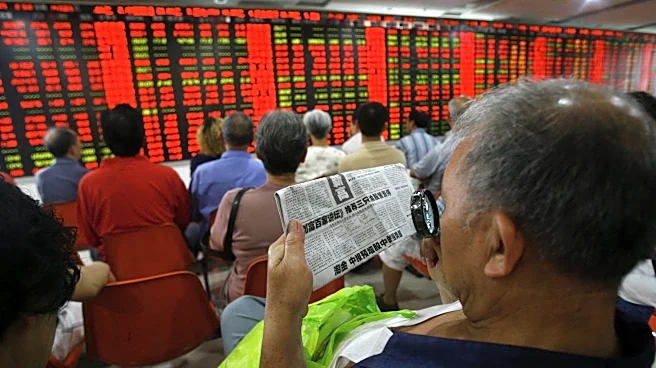
Hong Kong stocks opened lower on November 12, with the Hang Seng Index declining 0.8% to 24,121 points and the Hang Seng Tech Index also falling 0.8%. Major tech giants experienced significant pressure, with Alibaba opening 2.19% lower at HK$98.4, falling below
the HK$100 threshold. Other leading tech companies like NetEase, JD.com, Tencent Holdings, and Baidu also saw declines. In contrast, the semiconductor sector bucked the trend, extending its strength. Hua Hong Semiconductor rose 2.53%, Iluvatar CoreX gained 3.46%, and SMIC edged up 0.65%. This positive performance in chip stocks was supported by an overnight surge in the U.S. Nasdaq and the Philadelphia Semiconductor Index, which climbed 1.6% and 5.66% respectively. New listings showed mixed results, with robotics technology platform Amicro Technology surging 37.58% on its debut, while memory maker Hosin opened flat.
Why It's Important?
The mixed performance in the Hong Kong stock market, with a decline in major tech giants and a rise in semiconductor stocks, reflects a complex and evolving investor sentiment. For U.S. investors, this divergence highlights the ongoing re-evaluation of technology stocks, particularly those with significant exposure to the Chinese market. The weakness in large platform stocks like Alibaba, coupled with active short-selling, suggests continued caution regarding their near-term outlook. Conversely, the strength in the semiconductor sector, driven by U.S. market performance and demand expectations for AI, indicates a shift in capital towards foundational technology components. This trend could influence investment strategies for U.S. funds with global portfolios, potentially leading to a reallocation of capital from broad tech platforms to specialized semiconductor and AI-related hardware companies, especially given the increasing focus on AI infrastructure.
What's Next?
The market will closely monitor whether Alibaba can stabilize near the HK$95 mark after falling below the psychological HK$100 threshold. The performance of other major tech giants will also be under scrutiny, as continued declines could signal a broader bearish trend for platform companies. Conversely, the semiconductor sector's ability to maintain its upward momentum will be a key indicator of investor confidence in AI-driven growth. The divergence between mainland China's A-shares, which saw the Shanghai Composite and STAR 50 Index gain, and Hong Kong stocks suggests that different market dynamics are at play. Investors will be looking for signs of stabilization in Hong Kong's broader market and continued strength in the semiconductor supply chain, which could be influenced by global AI developments and U.S. tech sector performance.
Beyond the Headlines
The market's behavior reveals a deeper narrative of capital rotation, where funds are shifting from established, large-cap tech platforms to more specialized sectors like semiconductors and robotics, particularly those perceived to be direct beneficiaries of the AI boom. The strong debut of Amicro Technology, a robotics platform, despite its loss-making status, underscores a speculative appetite for AI-related ventures. This indicates that investors are increasingly prioritizing future growth potential in emerging technologies over immediate profitability for certain segments. The active short-selling in major tech names like Alibaba and Tencent also points to a cautious outlook on their regulatory environment and growth prospects, contrasting with the optimism surrounding the foundational technologies that power AI. This dynamic could lead to increased volatility and a more fragmented investment landscape within the broader technology sector.