






What's Happening?
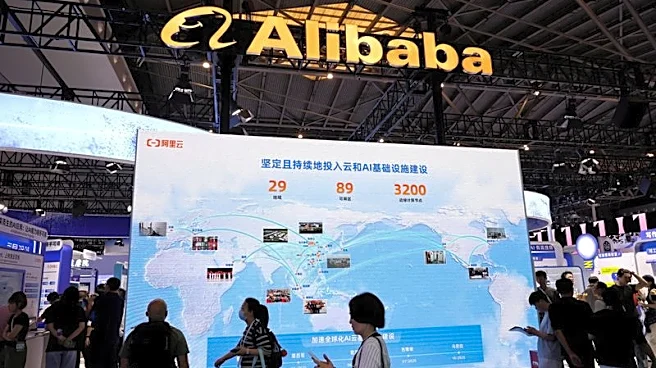
Alibaba Group Holding announced its plan to issue HK$80 billion (approximately US$10.2 billion) worth of new shares, with the entire proceeds dedicated to investing in artificial intelligence (AI). The Chinese tech giant stated that this move aims to extend
its global AI leadership and will be used to enhance and expand its full-stack AI capabilities, including infrastructure. The decision to increase the offering size was made due to strong investor demand, with pre-launch indications of interest exceeding the deal size, particularly from sovereign wealth funds and global long-only investors. This announcement follows Alibaba's report of a 45% year-over-year increase in its cloud and AI businesses' second-quarter revenue, with capital expenditure in these areas growing by 75% to 67.7 billion yuan (US$10 billion).
Why It's Important?
While Alibaba is a Chinese company, its significant investment in AI has global implications, particularly for the U.S. technology sector and its competitive landscape. A stronger, more advanced Alibaba in AI could intensify competition in areas like cloud computing, large language models, and AI applications, impacting U.S. tech giants that operate globally. This move underscores the global race for AI dominance, where substantial capital investment is seen as crucial for securing leadership. U.S. companies and policymakers will be closely watching how Alibaba's enhanced AI capabilities translate into market share and technological breakthroughs, potentially influencing their own investment strategies and regulatory approaches to maintain competitiveness and national security interests in AI. The increased capital expenditure by a major global player like Alibaba also signals a broader trend of escalating investment in AI infrastructure worldwide, which could affect supply chains for critical components like advanced semiconductors, impacting U.S. manufacturers and consumers.
What's Next?
Alibaba expects its investments in AI computing to break even within three years, with the potential for this payback period to shorten to about two years as gross margins continue to rise. The company will likely proceed with the share issuance and begin deploying the capital into expanding its AI infrastructure and developing new AI applications. This will involve further research and development in areas such as chips, computing infrastructure, and large language models. The increased investment is anticipated to accelerate Alibaba's transformation from an e-commerce giant into a comprehensive AI player. Competitors, including U.S. tech companies, will likely respond by evaluating their own AI investment strategies and potentially increasing their R&D spending to keep pace with the evolving global AI landscape. The market will also observe how these investments translate into tangible products and services, and their impact on Alibaba's financial performance and global market position.
Beyond the Headlines
Alibaba's substantial investment in AI reflects a broader strategic pivot by major global tech companies towards becoming 'full-stack AI players.' This goes beyond merely integrating AI into existing products; it involves controlling the entire AI value chain, from chip design and computing infrastructure to model development and application. This vertical integration strategy could lead to more closed ecosystems, potentially challenging interoperability and open-source AI development. For the U.S., this trend raises questions about technological sovereignty and the potential for divergent AI ecosystems. It also highlights the ethical and governance challenges associated with powerful AI, as companies like Alibaba develop increasingly sophisticated models that could have far-reaching societal impacts. The race for AI leadership is not just about economic advantage but also about shaping the future of technology and its influence on global power dynamics, making the ethical and regulatory frameworks surrounding AI development increasingly critical.